Everest/Lhotse 2016: Season Update

This is a summary of the Everest 2016 as of April 15, 2016 along with my own observations from Everest Base Camp as I am here climbing Lhotse with Kami Sherpa as part of the Altitude Junkies team. Please remember that I climb and do these dispatches all to raise awareness and research fund for Alzheimer’s. Please visit this page for more information. It has been a week since we arrived at Everest Base Camp. Time actually flies by even though we have done very little! The idea is to rest and let your body adjust to new altitude – 17, 300 feet or 5273 meters by taking what are called ‘active rest days’. This way you can accelerate the process thus on different days we hiked up to 18,000’ and then to 18,700’ on the flanks of Pumori.We were rewarded with great views of both sides fo Everest as you can see in the following gallery. The weather has been warm, almost like late May but there have been no reports of difficulties in the Icefall or in the western Cwm by the Sherpas. In fact some reports have Camp 2 at 21,500 feet quite cold at -4F/-20C. In my tent it usually reaches about 17F at night, so I’m appreciating my down sleeping bag! Right now, I am in the Altitude Junkies dining tent in short sleeves, with a temp around 65F at EBC. Base Camp has slowly filled up and is spread out like I have never seen, This my 6th time at EBC, not including a visit in 1997. There is one main path that serves as a main street for both people and pack animals. There are about 30 teams here that range from two people to over 100. Each camp is like an ink blot that spread onto the adjunct ones, it’s difficult to tell the difference given everyone uses the same yellow big tents and sleeping tents from the usual suspects of climbing gear: North Face, Mountain Hardwear, Ozark, etc. The helicopter traffic has been slower than usual. Not sure if this is due to fewer people getting sick or limited budgets. But it is usual to have about ten helicopter landings a day. There are three pads built across EBC. Everyone stops and watches the choppers slowly fly by, make a lazy loop and gently land on the rock landing pad. They leave their rotors spinning as the loads and people get on and off. We have a great view of the Icefall from base camp. It looks a bit less jumbled than last year. The Icefall Doctors reports about 20 crossings in the Icefall and only a couple in the Western Cwm. Some Sherpas are reporting the routes is bit more difficult than in 2015. Today, Friday April 15, there a lot of Sherpas from many teams in the Icefall. Our Altitude Junkies 14 Sherpas left camp at 2:00 am and made it to Camp 2. They will only make one more carry leveraging the gear left at Camp 2 in 2014 and 2015. We will go half way up the Icefall tomorrow and all on our rotation to Camps 1 and 2 next week. More on that in a later post. Like many teams, we had our Puja yesterday. A Lama walked in from Dengboche to conduct the ceremony. He chanted Tibet prayers for our permission to climb, safety for the climbers and forgiveness for damaging the mountain with our sharp crampons and ice axes. All our Sherpas and members joined the ceremony sitting quietly next to the Lama. We threw rice in the air, spread barley powder on one another’s face to symbolize old age (the Sherpas say 105 years-old!). About half way thru the ceremony, the Sherpas hung the prayer flags from a long pole attached to the Puja alter across put base camp. With each wisp of wind the prayers printed on the red, yellow, green, blue and white flags (that symbolize the elements of earth) are sent to the Mountain Gods. At the end of the ceremony, the Sherpas break out the rum, beer and chang – a Sherpa moonshine. We all laugh with each sip of the ceremonial beverages and politely say no, no, no only to have your cup refilled. Everything comes to a fun end with Sherpa line dancing! So, Everest 2016 is going well. We hear avalanches off Pumori and Nuptse each night. We look at the Icefall with awe and respect. We look at each other with dreams and confidence. As we were climbing up Pumori, a medium avalanche came off Nuptse, well away from any path or camp. It was quite the blow and a reminder that these are wild mountains that are never tamed or conquered. Climb On! Alan Memories are Everything
Everest/Lhotse 2016: Icefall Officially Open
The Icefall Doctor officially opened the Khumbu Icefall for climbers this morning. IMG sent a handful of Sherpas with loads to Camp 1 and a couple to investigate the route to Camp 2. They had their Puja yesterday. We understand the route through the Icefall is good this year. Meanwhile more teams continue to stream into Everest Base Camp so members should be entering the Icefall soon. We were greeted this Monday morning with a brief snow squall but there was no accumulation at base camp. The temperatures continue to be very warm and it is fairly windy each day. Usually there are a few snow storms throughout April, but thus far the area is dry, but it is still early. Kami and I took a short walk to 18,000 feet around Camp 1 on Pumori while the rest of the team did a bit of ladder practice. We were rewarded with great views of Everest, Lhotse and the Icefall plus Base Camp. Kami felt the Lhotse Face looked very icy. He said the area had a very dry winter. Alzheimer’s One of the pure research non-profits I have supported since 2008 is the Cure Alzheimer’s Fund. Please visit their site to learn more but here is some information: The Cure Alzheimer’s Fund is a non-profit organization dedicated to funding research with the highest probability of preventing, slowing or reversing Alzheimer’s disease through venture-based philanthropy. Since its founding, Cure Alzheimer’s Fund has contributed more than $34,000,000 to research, and its funded initiatives have been responsible for several key breakthroughs—including a potential ment recently selected by the National Institutes of Health (NIH) for its elite “Blueprint” drug discovery program, and the ground-breaking “Alzheimer’s in a Dish” study, which promises to greatly accelerate drug testing and was reported by the New York Times as a “giant step forward”. A few pictures from last night and this morning. Climb On! Alan Memories are Everything
Everest/Lhotse 2016: Arrival at Base Camp
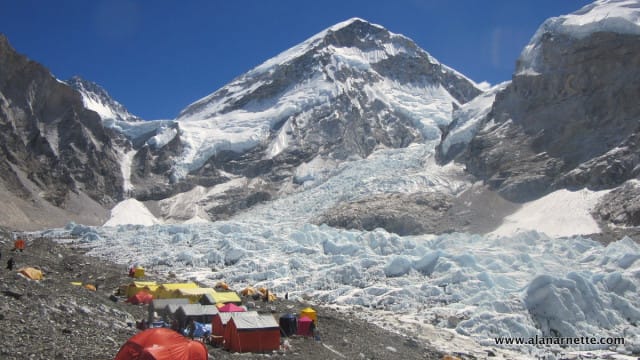
I walked by Gorak Shep, the last and highest of the Sherpa villages, on the way to Everest Base Camp (EBC). The climber and trekker traffic has picked up considerably. The walk to EBC follows a narrow dirt path along the top edge of the age-old moraine dug out by the Khumbu Glacier. Yak trains have priority! Their bells ringing, some are decorated with red ribbons and even prayer flags – they are oblivious to all this and seem content to plod along slowly regardless of their load – or their drivers whistling at them or even tossing the random rock their way. They exhibit a zen like focus! I looked at the glacial ice that cut out the deep valley. A few small lakes emerged as I neared EBC, but mostly it was dirt covered ice with huge pinnacles standing upright like solders at attention. However, it was just a matter of time until they too fell. As I crested one small hill, the snoot of the Khumbu Icefall came into view. I knew if I looked closely I would be able to spot the tents of base camp. Sure enough, a long line of large yellow tents appeared, surrounded by small tents. This was Himex – Russell Brice always choose a site far away from the base of the Icefall as he usually has a large team and requires a large space. This year, he only has five members, but is hosting 14 filmmakers from Discovery Channel working on a documentary about Everest helicopter pilots. Next to him I spotted IMG with their huge green canvas tents. With over 40 members and maybe 100 Sherpas they also require a lot of space. Then I noticed more yellow tents far away at the absolute base of the Icefall, literally hundreds of tents. Base Camp was spread out like I have never seen. It was long and narrow, squeezed between the ice of the glacier and the walls leading to Pumori. The landscape had changed bit from last year, but it always does. Curiously many camps were still in the same spot that took the direct impact of the earthquake induced avalanche off Litgren/Pumori last year. I slowly walked across the glacier and into EBC proper. My emotions were as varied as the scene before me. I focused on the moment with gratitude for the opportunity to return and shut out the distractions. I walked slowly, deliberately and soon found the Altitude Junkies base camp. It was large for our 6 person Everest team plus me for Lhotse. With 20 Sherpas in support. Phil Crampton takes great pride in his camp. He has a dedicated large tent for the Sherpas to eat, a cooking tent, dining tent, storage tent and two smaller toilet/shower tents for men and women. And of course the sleeping tents. Similar to others when totaled, there will be around 1,000 people making base camp their home for April and May. Nelson Dellis and I took a walk in search of the EverestLink card that would give us Internet access. It costs US$50 for 1GB of data. Ncell, the cell phone company has phone service at base camp but 3G connection is sparse and will require some exploration to find a good connection. We ended up at EverestER, the volunteer organization that provides full medical services for everyone at base camp – porters, Sherpas, members – as long as the members of the expedition pay $100 each – an incredible bargain and valued service. They need funds after the last two years destroyed their camp and depleted a lot of their supplies. I’ll do an interview with them in a few weeks. As I walked through the long base camp, I didn’t recognize many of the names stenciled on the tents. Take these five words: Himalayan, Trek, Holiday, Adventure and Sherpa and combine them in any possible way and you have the names of local Nepali companies who have found members to lead on Everest. I have been predicting that the locals would take over Everest and based on this walk thru, the transition is well under way given many long time Western operators have half their usual members and some are not here at all. We returned to our base camp for an early dinner and then to bed. Overnight, the temperature bottomed out a reasonable 17F – warm for this time of year. The Icefall Doctors are said to have the route almost to Camp 1 and should be finished to Camp 2 in a few days. The expeditions will take over there to fix the route to the summit. This year, the Ministry of Tourism has given them permission to use helicopters to get ropes and gear to Camp 1 thus saving 85 Sherpa loads through the Icefall. There are many reports that Sherpas making 30 one-way climbs through the Icefall, the Altitude Junkies Sherpas will do about 18 in total. This is due to Phil choosing to forgo any type of luxury at Camp 2. He also has the Sherpas start using oxygen at Camp 3, most begin at Camp 4 on the summit push. Finally they carry maximum loads of 20 pounds where some Sherpas carry in excess of 50 pounds. So as you can see, it is difficult to make gross generalizations. But the heavier the load, less use of oxygen and fewer support staff translates into lower costs to the members but more work, and risk, for the Sherpas. The Lamas have chosen April 14 as an auspicious day thus that is when we will have our Puja so we will be resting and acclimatizing while we wait. A steady stream of teams are arriving this weekend and a few teams are doing acclimatization climbs on Lobuche. It looks like total climbers are down about 15% from 2015. There are 385 climbers on Everest (279), Lhotse (72) and Nuptse (34) for 2016. 40% of the permits are extensions from
Everest/Lhotse 2016: The Other Side of the Mountain
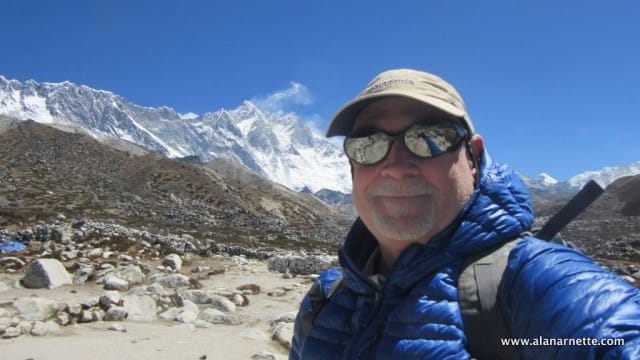
Every mountain has two sides, or more 🙂 As we took an “active rest day” at nearly 14, 500 feet in the village of Dingboche, we took a walk and were rewarded with seldom seen sides of two famous peaks: Lhotse and Ama Dablam. We ran into a few climbers on their way back from Island Peak, a popular ‘Trekking Peak’ that sees many summits each season. It was nice to visit with Melissa Arnot who is taking the season off from climbing the big peaks to guide an impressive 13 year-old throughout the Khumbu. They had just summited Island. My objective was to see the South Face of Lhotse Peak. I last saw it in 1997 on my first visit to Nepal and a trek to Everest Base Camp. We took a small detour to see Face. This impressive mountain wall is rarely climbed and has taken many lives. There is a memorial to three Polish climbers who died attempting it. Over the past three years, an amazing team of Korean have given it their all but have come up a bit short of making the top. It is steep, full of hanging seracs and avalanche prone, other than that, it’s a walk-up! I stood there today once again in awe. It brought back memories of that 1997 trek and how Nepal and the Khumbu changed my life. Now I look at these walls as more of a climber, but this one will never feel my crampons. I will be fully satisfied if I can reach the top from the other side in a few weeks. The other peak I saw was the North Ridge of Ama Dablam. I must have hundreds of pictures of the Southeast Ridge, the route I summited via in 1999. But the other side is a totally different mountain. It is steep, and full of cornices. Russell Brice climbed it in 1989 has attempted it a couple of times in recent years only to be stopped by the very last ridge which is full of loose soft snow. These mountains, and many more, offer so many routes beyond the most popular ones that when I hear people complain about crowds, I think – why not try the other side? Everest News We are hearing that Everest Base Camp has very few people and we are witnessing very people on the trek in so the recent reports that over 350 Everest permits have been issued does not match. We will see once we get there and get a head count based on the Expedition Operators Association’s need to collect money for fixing the upper mountain. The weather is fairly normal with clear mornings, and afternoon clouds. This far no rain or snow for us. We will arrive at Everest Base Camp on Saturday April 10. I will have limited internet until then. Alzheimer’s • NO CURE, always Fatal • No easy, inexpensive method of early detection • 3rd leading cause of death in the US • New case every 68 seconds, 4 seconds worldwide • Impacts more than 5+m in US, 25m+ worldwide • Devastating financial burden on families • Depression higher for caregivers • Issues are increasing rapidly as population ages Climb On! Alan Memories are Everything
Everest/Lhotse 2016: Living in the Moment
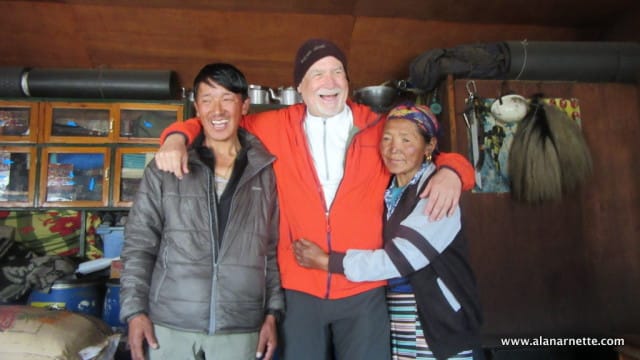
Sometimes you have to look behind you to appreciate where you have come from before you go on in order to live in the moment. As we left the Rivendale Lodge at Deboche, we walked thru the last vestiges of the pine forests knowing it would be weeks until, as Anatoli Broukreev said, “touch grass again.” As usual, I walked along in my own world, lost in thought thinking of the day ahead. I would soon see Kami Sherpa, my climbing companion and Sherpa on Everest, K2 and last year in the Western Cwm during the earthquake, for the first time after his accident on K2 last summer. I would also see his wife, mother and sister again. Along with five members of my team, we would visit Lama Geshi. All of a sudden, for some reason I came to a full stop and looked behind me. I could clearly see the Tengboche Monastery that we visited yesterday. It was surround by pine trees with a beautiful backdrop of snow capped mountains. I simply stood still for quite a while letting the scene sink into my memory. I could still hear the monks chanting in my mind. The corner of my mouth formed a small smile. I was using the present to have gratitude for the past while eager for the future to come. We walked into the tiny Sherpa village of Pangboche. I was pleased that there was little visible damage to the stone homes, but upon closer inspection large cracks were visible along the joints. I wondered what the next large quake would do to this beautiful village. In a sign of changing times, I called Kami’s cell phone from my cell phone. “Hello Alan, I will meet you outside my home.” Soon I almost ran to embrace by dear friend. I held him tight, then eased fearing I might hurt his shoulder. But he was fine. He looked like Kami I know – small, fit, dark hair, his eyes revealed a spirit that many their entire life. And a smile of contentment few have in this world. We followed him along the tree lined dirt path, passing a very old Sherpa woman holding onto the brick wall as she used a cane to keep her balance. As we passed her, she smiled and gave us the greeting of ‘I see the light in you’ or “Namaste.” We entered the lower level of Kami’s home, somewhat fixed from the earthquake damage but with more needed. The lower level is home to the calf – a key element in this Sherpa circle of life. We climbed the well worn wooden stairs to the kitchen – a small iron wood stove, surrounded by benches. The adjacent room, the only other room, served as the living room, bedroom and prayer room; oh and also the storage room. We sat on cushions on the sleeping benches and Lhapka Diti served us black tea. For the next hour we sat and talked. We laughed and smiled. Diti kept us entertained as she called me her father and insisted on everyone writing their name on a piece of paper and then sounded out the letters with her limited english. But words were unnecessary. Communication was conducted thru smiles, laughs hugs and holding her’s and Kami amazingly warm hands. Next Kami led us up more dirt paths to Lama Geshi’s small stone home. The 84 year-old Lama looked wonderful. He was full of life, his smile big as ever and that laugh – a deep gravely chuckle that make it impossible for you not to join in. This was my ninth visit with him. We took our seats and a quiet reverence took over the room. With Kami as host, he translated Lama Geshi’s Tibetan into Kami’s form of English – but we understood. The blessing took about an hour starting with blessing the prayer flags that will fly over our tents at base camp and camp 2. Then one by one we accepted a personal blessing from the Lama compete with a personalized card that we are instructed to take to the summit, a sting tied around our neck aka a sundi and most importantly his blessing to climb the mountain. During my turn, my eyes closed between looks into the Lama’s eyes. The moment was simple. The moment was real. There was no past, no future only the moment. He competed the blessing with throwing rice into the air then a sprinkle of water finally touching our shoulders, knees and wrists with a brass ornament. At the last moment, he instructed Kami to help and created an individualized sachet that held a tiny sliver of an eagle’s feather. It is said an eagle flew to the South Col or 8000 meters on Everest and died. A Sherpa brought his wing down and gave it to Lama Geshi. It is said the eagle’s spirit still flys around Everest. We touched foreheads, held hands, shared smiles and a few more laughs before saying goodbye. H made us promise t visit him after our climb something I did after my 2011 Everest summit. Kami and my summit teammate Mirjam, visited the old Lama that year and he was delighted as few people complete the cycle after the climb. We returned to Kami’s home where Diti now served us milk tea. More visiting and talking about their five children. She was very proud of her daughters who are in boarding school in Katmandu, her son who will soon get his Electrical Engineering degree, her oldest son who is a mountain guide and her other son who is a monk at the Tengboche Monastery – all made possible by Kami’s income through climbing. But soon we had to go. As we left the last tree that defined the village of Pangboche, I turned back around to look. I could see the Monastery, the potato fields, the stone houses with the green roofs, Kami’s home. Another moment in
Everest/Lhotse 2016: A Beautiful Day Trekking in the Khumbu
Another beautiful day in the Khumbu. After a few days of low clouds and a bit of rain, today was absolutely perfect. We were rewarded with stunning views of Ama Dablam, Lhotse, the Nuptse ridge and, of course, Everest. Once again, I was struck by the lack of traffic on the trail. I only saw one large trekking group. Perhaps we are between the groups but the teahouse owners report business is down. From my perspective, the Khumbu is very quiet. Our Altitude Junkies team of eight, quickly spread out and I found myself walking alone at my own pace, lost in my own thoughts. I went back to my first trek here in 1997 to Everest Base Camp, to my travel to Ama Dablam in 2000 and the treks for my Everest attempts/climbs in 2002, 2003, 2008 and 2011. While a bit has changed, a lot has not. The views remain stunning. The sound of the rushing rivers keep you company as do the ever present yak trains with their bells ringing announcing their arrival. I always stood on the uphill side knowing that there have been some unfortunate incidents where people have been pushed down steep hillsides by the unknowing furry beasts. I took at break at the base of a long descent to reflect on these times then began the long uphill walk to the Tengboche Monastery. I was eager to see if the 2015 earthquake damage had been repaired. The trail is along a fairly wide dirt path mostly within a pine forest. Once again the views of the surrounding 20,000 foot mountains is stunning. We arrived at the Tengboche Monastery in time to sit quietly on the floor as the monks did one of their several daily prayers. There were more monks there this time than last year. As always, I found the chanting and beating of the drums an opportunity to allow myself to go deep in thought as well as to try to take in the moment and have gratitude for where I was. I asked my teammates for a one word description of the day: Nelson – heavy Laura – yak Lyle -monotonous Ben – pleasant Phil- uncrowded Gabby – grateful Barbara – peaceful and mine – memories Climb On! Alan Memories are Everything A few pictures and videos from the day:
Everest/Lhotse 2016: A Day around Namche
We went to the Everest View Hotel and were rewarded with a nice view of Everest, Lhotse and Ama Dablam between the clouds, then to Khumjung for a visit to the Sir Edmund Hillary school where the boys were playing football in the fog. Plus some yaks decided to break free! 🙂 News: Weather has been unusually cloudy and a bit rainy from Lukla to Namche Many teams have had problems flying in have used more expensive helicopters extensively Many teams are already in the Khumbu making the trek to Everest Base Camp North side teams are starting to arrive and cross the Nepal/China border 206 Everest permits have been issued to 24 different teams as of March 30. Climb On! Alan Memories are Everything
Everest/Lhotse 2016: Khumbu Echoes
The alarm went off at 5 am this morning; I was already awake. I looked over at my trekking pack next to my hiking shoes, my red jacket draped on the back of a hotel chair. In a few hours, I would be back in the Khumbu on my way to Everest Base Camp and an attempt on Lhotse Peak – for the second year in a row. I was hoping for one last, long hot shower before leaving the hotel but the tepid water cut my plans short. I shaved as closely as I dared knowing it had to last a few days before I began to look like a homeless Santa Claus with a white bushy beard. As I shaved, I looked into my own eyes, and deeper – was I prepared to go back? Returning to Nepal was an easy decision. The country badly needs tourism dollars. The Sherpas need work. I heard that compared to last year, only 60% of the Sherpa community had found work this season. My first visit to Nepal in 1997, a trek to Everest Base Camp, changed my life. I became exposed to Eastern cultures and the natural spirt of a beautiful people. And those mountains … As we flew towards Lukla, I took on the thousand yard stare, letting the terraced hillsides go by in a blur. My mind went back to the many other flights just like this. Each trip had been different. I found life lessons in each experience, regardless of the result. If I didn’t achieve my objective, I came back. Over the years, however, my objectives shifted from summits to Alzheimer’s, and I made more summits. The clouds were low today, shielding the snow capped Himalaya peaks from our peering eyes. The helicopter pilot appeared to have laser vision following an unseen highway in the sky directly towards Lukla. As I stepped onto the ground, a wave of satisfaction, and mission, came over me. I’m back. My emotions are unbridled. My thoughts flow like a paper being blown by the winds. I think about flying out the Western Cwm almost exactly one year ago today after the earthquake trapped us at nearly 22,000 feet. I think of Eve, our team doctor and her death at base camp. Her 27 year-old amazing spirit that touched everyone, taken in a blink; her’s and 9,000 others throughout Nepal. I think of my mom, Ida, and how she always said to me after an expedition “Well, I’m glad you got that out of your system.” I think of those back home. The love, support and understanding that when I climb mountains, it is more than climbing mountains. I am writing this in my favorite coffee shop in Namche Bazaar, my coffee now cold as I’m lost in thought. The background sounds are a Tower of Babel with multiple nationalities doing what people do in a coffee shop. The Sherpa staff falling asleep, bored with few people to serve. The music is a mix of rock and roll and blues complete with soulful guitar riffs. A team of Dzo’s make their way by on the dirt path that defines main street in Namche. Their bells announcing their arrival, their eyes staring at the path ahead. As I walked to the coffee shop from the stone teahouse at the top of the amphitheater that makes up this Khumbu village, I stopped at the top of a steep path leading lower, defined by stone steps. I took the air deeply into my lungs. It was cool, crisp mountain air – clean air. The clouds cleared enough to show a small patch of blue sky. Across the valley, a ray of sunshine lit up a snow filled gulley that traveled from a raging river below then up 2,000 feet on a steep Himalayan hillside. On the top, the skyline, the trees defined the ridge line by standing side by side like climbers with an interminable dedication to their goal. As my mind drifted, sealing this view in my memory forever, a loud shrill filled the air followed by a laughter that only little girls are capable of creating. I started down the stone steps, one by one, taking this all in. I moved passed yet another stone building, then a dirt courtyard emerged holding three young girls. It appeared that it was two again one and the one was winning – with her laughter. The game they were playing was impossible to determine or understand, but all that mattered was that they understood and had perfect technique! As I stood there, a bell rung above me – a baby Dzo, the odd result of breeding cows with yaks stopped one step above me. He avoided eye contact. I avoided all contact. I stepped aside and he moved on. The girls had now spotted me as I held my camera in my left hand ready to capture the moment. They fled the scene into their stone house. All that remained was the echoes of their laughs. I am glad to be back – in Nepal, in the Khumbu, in the mountains. I feel the spirit of so many. The sounds of their spirits echo off the hillsides saying “Wel come back. Namaste.” Climb On! Alan Memories are Everything
Everest/Lhotse 2016: Signs of a Quieter Season.
I arrived in Nepal and immediately felt something was different. The normal crazy drive from the airport to the hotel was, well, almost relaxing. Traffic was reasonable, drivers almost polite … Kathmandu has changed. In speaking with guides and other climbers, there is a sense of calm anxiety about this year’s Everest season. Perhaps it is more of a sense of capitulation to the inevitable forces of nature that no one can control, or anticipate. However, there is also a deep sense of hope that this year will be quiet, with no-drama; peace in the mountains. Permits Down The Himalayan Times reported today that 206 Everest permits had been issued to 24 different teams. Of these totals, 60 members are from military units around the world, fairly normal in recent times as climbing Everest has become a “perk” for many military operations, especially from India. I am estimating on the Nepal side of Everest that with around 230 non-nepali/Sherpa Everest climbers, a bit down from the 265 permits issued last year, and perhaps 50 for Lhotse, also down from the 93 permits in 2015, the flanks of Sagarmatha will be quieter. It will take a few more weeks to get the final numbers for the Nepal Ministry of Tourism. On the Tibet side, it appears to be a busy season with more climbers than normal. 7 Summits Club has 26 members, including a seven person female team. SummitClimb is reported to have a large team as well. It will be interesting to see if the crowding situation has just shifted from the south to the north. While it seems that the climbers may be down, some first hand reports from the Khumbu note a lot of trekking activity there. A Changing Guide Picture As I covered in my three part series: Everest a Changing Mountain the guiding situation is changing on Everest. Looking at the makeup of the teams for 2016, some long time major guides have significantly lower numbers, for example Alpine Ascents with two members, and Himex with five. Alpenglow has two members on the Tibet side. Some of the regular western guides are not here at all, Benegas Brothers, , Peak Freaks and RMI for example. Dave Hahn, with 15 Everest summits, is not here for the first time in years. But Sherpa owned and operated Seven Summits Treks has over 40 members. Bucking the western trend is IMG also with over 40 members. Both of these companies offer their south side Everest climb well under the $65,000 often quoted in the press coming in between $35,000 to $45,000 for a Sherpa lead climb. A couple of the high-end priced outfits ($60K and up) like Adventure Consultants and Madison Mountaineering have full teams but some have cut their defintion of ‘full’ to only 8 or 9 climbers – down from 15 in 2015. Some of this is due to insurance covering 100% of the 2014 and 2015 season cancellations combined with those permits being extended a few years thus encouraging people to climb sooner rather than later. Look for 2017 to have record crowds from Nepal based on these factors. Base Camp under Construction Multiple Sherpa teams are at Everest Base Camp building tent platforms for the expanse of dining, cooking and sleeping tents required by the 800 or so inhabitants currently enroute. The location of the camps has not changed since the 2015 avalanche off Pumori/Lintgren that took 18 lives. In general, the earthquake induced avalanche was felt to be an anomaly thus not requiring moving base camp from its tradition location. In all fairness, it is not clear where base camp would be moved as the terrain at the base of the Khumbu Icefall does not offer many options. Icefall route The Icefall Doctors continue to make progress establishing the ladders and fixed rope through the Khumbu Icefall. While several press articles have highlighted “large holes and cracks”, my local sources tell me it is not much different than last year and follows basically the same route. One MAJOR change for 2016 is that the Nepal Ministry of Tourism is allowing the fixed ropes, anchors and oxygen used by the summit rope fixing team to be transported by helicopter to Camp 1 in the Western Cwm. This gear will be used to fix the route to the summit, not to be confused with the Icefall Doctors who only fix the route to Camp 2. The significance of this is that it will eliminate 85 trips through the Khumbu Icefall by Sherpas, a meaningful change is how to make Everest safer when climb from Nepal. The Expedition Operators Association (EAO) deserves credit for driving this change. A ‘Dry’ Year The Sherpas are reporting that base camp is dry and windy at the moment. There is talk that 2016 could be similar to 2012 with little fresh snow on the Lhotse Face. In 2012, this created a dangerous situation with a lot of rock fall causing the Sherpas to take the fixed line climber’s right of the normal route up from the base of the Lhotse Face. This adds about half an hour to the climb from Camp 2 to Camp 3 but is safer from the rockfall. Summit Oxygen Finally, a bit of an update on my Lhotse climb. I will be using oxygen supplied by Summit Oxygen. I met with Neil Greenwood this morning to go over his latest system branded the Elite System. The Summit Oxygen system is now used by many commercial guides including Adventure Consultants, Altitude Junkies, Alpenglow, Himex, Jagged Globe and Madison Mountaineering. The innovation is a flow control valve located on the tube from the oxygen tank to the mask. This allows the climber to regulate oxygen flow, adjusting it to a lower flow when at rest or a higher one in moments of high demand thus when carefully managed can make the oxygen last longer. The prior adjustment method required a Sherpa or teammate to make any adjustments on the regulator located on the bottle in the backpack. Obviously, this system requires a great deal of personal responsibility for the climber so as not to turn the flow rate to maximum and run it of oxygen. As is customary, Kami Sherpa who is climbing me with use the same system albeit at a lower flow rate.
Everest/Lhotse 2016: Preparing to Leave
How many times have I written that headline for myself, and for so many others? Its the end of March and climbers from around the world are on airplanes flying to Kathmandu in hopes of reaching a long sought after goal. For many, too many, it is deja vu – all over again. Excellent Kathmandu based reporter Rajan Pokhrel wrote for the The Himalayan that only 71 Everest permits from 10 teams had been issued as of March 10. There is always a mad rush towards the end of March and into early April so this number will certainly increase. I’m expecting about 200 Everest permits, down from the 265 in 2015. Of the 77 permits issued for 2016, 33 were reused from 2015. Dreams Newfoundland climber, TA Loeffler, who is returning to Everest for her third time posted this request from her followers. Follow her blog closely, she is a wonderful writer and I wish her the : Send good thoughts. While I am climbing, send me some good thoughts. Say a prayer. Do a mantra. Light some juniper. Hold me in the Light. Whatever way you might chose to do it, ask for my protection and safe return from the mountain. Send me strength, energy, and perseverance. Beam me wisdom, courage, and compassion. Wish me luck over and over again. David Liano, from Mexico, with five summits including from both sides, now wants to attempt climbing without supplemental oxygen. IceFall Doctor Training The climbing community lead by the Khumbu Climbing Center has been training the Icefall Doctors on techniques the last few weeks. This is the third year that the training has taken place. Conrad Anker and Pete Athans, The North Face Athletes, have lead this effort along with instructors Phu Nuru, DaNuru and Panuru Sherpa. Pemba Sherpa of the Sherpa Foundation told me: they are one of the hardest and dangerous job on mt. Everest. Sherpa Foundation, Petzl, AlexLow foundations are the sponsor this this safety training. There are 3 Instructors and 12 Ice doctors on Everest right now. The instructor from Khumbu Climbing School and SPCC are organizer of this. We feel very fortunate to be part Sponsor of this very important safety training. Phunuru Sherpa is the lead instructor on this. Pete Athans added: Just received word from one of our Instructors, Phu Nuru Sherpa, who has just arrived in Phortse after 10 days at Everest Basecamp. The Icefall Doctors’ training has been completed and the team is now working on establishing the route through the icefall to camp one in what we hope will be a good season on Everest for everyone attempting to climb this year. Apparently, the training went exceptionally well and big thanks to everyone from the Icefall Doctor team, the Sagarmatha Pollution Control Committee and the Buffer Zone committee who have contributed time , resources and energy in making this specific training possible. Lastly, though, of course, to everyone at the Khumbu Climbing Center, Alex Lowe Charitable Foundation as well. Specifically, Instructors Phu Nuru, DaNuru and Panuru for their professionalism, expertise and generosity in spending excellent time with such deserving candidates. Icefall Progress – lots of ladders! The Doctors are reported to have the route through the Icefall and approaching Camp 1, however according to this report in the Kathmandu Post, they are having a bit if difficulty: Although a week has passed since they began their work, the high-altitude spets have not yet reached Camp 1 due to difficulties in installing the equipment. “There are several cracks and holes along the Everest route this year,” said Ang Kami Sherpa, adding last year’s earthquake might have resulted in the cracks. “As a result, we need more aluminium ladders this year compared to previous years to navigate through the cracks and holes.” According to Sagarmatha Pollution Control Committee (SPCC), more than 40 ladders have been installed below Camp 1, and the number could hit 200 by the time the Icefall doctors reach Camp 2. Note that these are probably individual ladders and not crevasse crossing. In previous years, there were between 20 to 30 crevasse crossing in the Icefall and another 4 to 8 in the Western Cwm. Each crossing could be anywhere from one to right ladders lashed together. Everest off the Standard Route A small two person team fromSlovakia will attempt the seldom climbed Southwest face: “After 2009, Vladimír Štrba and Zoltán Pál from Slovakia are going to make the summit attempt using the dangerous south-west route this spring,” Ganesh Thakuri of Utmost Adventure Trekking said. Annapurna and Others Not be left out, there are climbers on other Himalayan peaks right now. On Annapurna, I have great friends who have already made an acclimatization rotation to Camp 2. Chris Burke (who has an excellent blog), Matt du Puy (my K2 summit teammate), Tunc Findek and Carlos Soria with his Spanish team, attempting all of the 8000ers – he has 12 – now at age 75; are all there. Over on Shishapangma, Ueli Steck and David Gottler Shisha Pangma will attempt to send a new route on the South Face. On Manaslu, Slovak Peter Hamor is attempting a new route in alpine style attempt on North Ridge. Dhaulagiri will be popular. Juanito Oiarzabal will be there along with a British Joint Services expedition. A few of the Annapurna climbers including Carlos Soria’s, Matt du Puy and Chris Burke will also make an attempt. My Lhotse Attempt And yes, I’m back to Nepal/Tibet for the 12th time. As I covered in this post, I want to give back to Nepal through supporting the climbing community, continue my quest of climbing the 8000ers and, of highest priority, continue my life’s purpose as an Alzheimer’s advocate. I posted this on Facebook yesterday: TBT: This one goes way back … to 1956, when I was three months old in the arms of my mom, Ida. I grew up in a different era than today. Times were a bit simpler, safer to be sure and family was the center of society and hairstyles were, umm, curly? I had a special relationship with my mom. We were always talking about