Tell Washington: We Must Stop Alzheimer’s
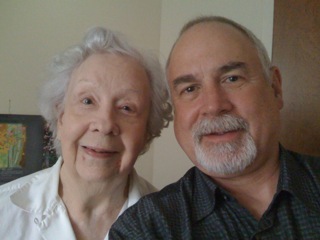
I have been an Alzheimer’s Advocate since 2007. I use my mountaineering, check speaking, and website to tell the story of my mom, Ida Arnette and our battle with Alzheimer’s Disease. In fact, my annual coverage of Everest is part of my efforts to raise awareness and research money for Alzheimer’s non-profits. You can read more about Ida and our journey at this link. Today, I’m asking that you join me in signing the Stop Alzheimer’s Petition. We must come together to stop this disease. Later this spring, a coalition of Alzheimer’s activists is going to present this Petition to members of Congress. We are making a push to raise our numbers, and it would mean so much to me if you would sign the Petition today. When you stand with me and thousands of others today, Congress and the White House won’t be able to ignore the voices demanding they take real action against this terrible disease. I signed for my mom, Ida, but it’s our collective voice that is more powerful than any one individual alone. By signing this Petition, you’re partnering with USAgainstAlzheimer’s and dozens of other leading organizations in the Alzheimer’s community to support this national call to action. So many others are fighting these battles with us, whether it’s caring for a loved one, advocating for more research funding or mobilizing communities to speak out and take action. On behalf of Ida and our family, thank you for joining us in this fight. Climb On!AlanMemories are Everything
The Christmas I lost my Mom
In 2001 we returned to Memphis to visit my parents over Christmas, something I had regularly done since leaving Memphis to start my career over three decades earlier. One of our annual traditions was going to the Christmas buffet at the famous Peabody Hotel in downtown Memphis. It was always special. We said hello to the ducks in the lobby fountain, enjoyed the huge, beautifully decorated Christmas tree and made our way up to the top floor ball room to pig out. It was grandiose as usual. Smart white table clothes covered round tables that surrounded the dance floor. There, the tables were filled with an endless selection of Eggs Benedict, smoked salmon, Belgian waffles, applewood smoked bacon, and prime rib. The service was impeccable. Ah, it was good to be home! We each got up, taking plate in hand, and started our search for our favorite dish. The following moment is locked in my memory forever. I noticed my mom walking around aimlessly. She was lost, not knowing where she was or who we were. As I went over to her, she seemed startled at my approach. “What do you want to eat?” I asked her gently. “Oh, you know, the usual.” was her noncommittal answer. My wife had commented earlier that morning that my mom was not changing clothes, putting on makeup or fixing her hair. Highly unusual given the importance she placed on how she looked in public. We asked if she was going to change clothes and she dismissed it quickly saying she looked fine. We helped her select a nice outfit. During the half hour drive to the hotel, she asked four times where we were going. We exchanged worried glances as the signs were there. Over Christmas and the following days it was clear my mom’s condition had worsened. But I didn’t know what I didn’t know. She had developed an odd pattern of repeating questions over the past several years when we spoke to her on the phone every Sunday. She told me the same story about her friends several times during the same conversation. She had lost interest in some of her favorite things, she seemed to have become more withdrawn, very usual for this social bee. She had trouble sleeping throughout the night. She no longer did her crossword puzzles. I spoke with neighbors who said they were worried about her wandering the street. Her church friends told me of similar experience with her memory loss. Her large clan of brothers, sisters, nieces and nephews in Memphis confirmed my observations. My mom was not growing old, she was sick. We talked to my dad privately. He said, yes he thought she had some issues but nothing out of the ordinary given her age. She was only in her mid 70s. My brother and I pushed him hard to get help, see their family doctor. I remember being on my knees, holding my dad’s 80 year-old hands as he sat in his favorite chair begging him to take action. He promised he would. Asking for help was difficult for this proud, independent man. Fueling the concern was that two of my mom’s sisters were already diagnosed with Alzheimer’s. In hindsight my mom had gone through the early and mid stages of dementia, probably Alzheimer’s, for as many as 10 years without us understanding what was really happening. It had sneaked up on us. One day, I’ll write about what I call the worst day of my life with my mom but not today. The next few years saw her condition decline, we did what we could. Her doctor confirmed, as he could, she had Alzheimer’s. My dad tried to keep her on Aricept but let the prescription lapse over and over. I don’t blame him, but now understand we could have done more. We represented the typical family today, spread across the country; established in cities with jobs, houses, families of our own. No luxury of snapping a finger to make things different. Maybe I should have. My mom died from Alzheimer’s on August 16, 2009. So as you make the pilgrimage across the country or town to see your aging relatives this Christmas, stay alert for any signs that something is amiss. If there is, take action, help. Learn the 10 warning signs. If you are looking make a difference in the world of Alzheimer, make a donation to a non-proift for research, awareness, education, public policy or caregiver support. Make a donation. If you are visiting someone with dementia this holiday, them just like you would anyone – that’s what they want. They didn’t ask for this condition but deep inside they are the same person they have always been. Learn holiday practices. The holiday are a special time, an opportunity to reflect, renew and enjoy. I wish the very for each of you. Climb On! Alan Memories are Everything [poll id=”3″]
Dear Santa, My Wish List

I hope everyone is having a good holiday season. I know I am but could use some more snow and ice here in Colorado for climbing! As I prepare my Christmas wish list for Santa, help I thought I would share it with you in hopes I can influence your list. All I want for Christmas is a dramatic improvement in the ongoing work to find a cure for Dementia, specifically Alzheimer’s Disease (AD), and help those tireless caregivers. So Santa, if you are listening, can you bring these five wishes true around the world? 1. Double the Real Funding for Research. Similar to the war on Cancer, and the fight on HIV/AIDS, Alzheimer’s researchers need billions of dollars for: Early detection. It is now thought that Alzheimer’s may start up to 20 years before symptoms appear. Slow the progression. Once symptoms start, there is no proven way to slow the progression, only to symptoms. It is truly the long goodbye. Cure: the holy grail. Alzheimer’s is the only disease of the top 10 causes without a way to prevent, cure or slow the progression. learn more at The Cure Alzheimer’s Fund 2. Global Education and Awareness Campaign Most people confuse signs of aging with dementia or they cannot name 3 of the 10 signs. During the holidays, children spend time with aging parents, and friends get together. It is a perfect time to know the 10 signs and reach out to anyone who needs help, including caregivers. A recent survey showed that 47% of U.S. public think Alzheimer’s is able. That is false. There is a stigma around AD and no one wants to talk about. We must be open and honest about this disease. It will take a large scale public awareness campaign to reach millions around the world and even more to gain the awareness that breast cancer has today. learn more at The Alzheimer’s Association 3. Make Alzheimer’s the Center of Public Health Policy Alzheimer’s Disease is larger than private companies can handle with their pressure on profits and long term models. Direct investment by Governments, the United Nations and the World Health Organization are urgently required. Today the US Government spends over $1.00 for dementia care compared to only $0.01 spent on research. This is upside down and wrong. Governments around the world must take a more pro-active role in funding research, educating their citizens and providing financial assistance for care. The National Alzheimer’s Project Act (NAPA) was signed by President Obama and unanimously approved by Congress but has not been fully funded. This is unacceptable. learn more at UsAgainstAlzheimer’s and Alzheimer’s Disease International 4. Increase Physician Training Recognizing signs of dementia is not a large part of every medical school’s program. And for many physicians, they were never exposed to basic training in the first place. So millions of people who could receive help, and their families, go on with their lives each year undiagnosed. In addition to is the need to guide families as their loved ones go through the difficult journey. The American Medical Association and other medical teaching organizations need to step up their efforts to train physicians today. learn more at the AMA 5. Create Dedicated Dementia Facilities A nursing home is not a place for most individuals with early and mid stage Alzheimer’s. These individuals are often fully functional and need mental stimulation – not a place to be parked until death. As the world’s population ages and families can no longer care for loved ones in their homes, there is an urgent need for special dementia facilities at a reasonable cost. learn more at Alzheimer’s Speaks Blog To learn even more, download the Alzheimer’s Association 2012 Facts & Figures report. Happy Holidays, Alan
Alan to speak at the Pat Summitt Foundation
Pat Summitt epitomizes courage and leadership. In her 38 years as a head coach, drugstore she never had a losing season. She is the all-time winningest coach in NCAA basketball history of either a men’s or women’s team in any division. She coached at the University of Tennessee from 1974 to 2012, all with the Lady Vols, winning eight NCAA national championships. She is simply put, a legend. But now she is also a role model for other reasons. On August 22, 2011, Coach Summitt, at age 59, told the world she had Alzheimer’s. True to form, Pat embraced her with courage. In November 2011, she announced the formation of her foundation, the Pat Summitt Foundation Fund, with the proceeds going toward cutting-edge research. The Fund will make grants to nonprofits which provide: Education and awareness of Alzheimer’s, its onset and ment. Support services to s, their families and caregivers Research to , prevent, cure, and ultimately eradicate this disease. You may make a donation today. With this background, I am incredibly honored to be speaking at a fund raiser event this Sunday, October 7 at the Clayton Center at Maryville College just outside Knoxville Tennessee. The tickets are $15 and all proceeds go to the Pat Summitt Foundation. This is a special event for me in many ways. I was born and raised in Memphis Tennessee and often visited my cousins who lived on Knoxville. The Smoky Mountains were the birthplace of my love of mountains. But more important was that my Aunt Chris, one of my mom’s five sisters also passed away from Alzheimer’s Disease. She lived in Knoxville. At the event, I will tell the story of my mom and her two sisters who died from Alzheimer’s, how it changed my life and took my on a journey of a lifetime with the 7 Summits Climb for Alzheimer’s: Memories are Everything. Also, I will be at River Sports Outfitters on Saturday October 6th from Noon to 2pm for a special signing of my recent Rock and Ice magazine article. If you are in the area, I hope you can attend. If not, I hope we can connect for me to present in your area one day. Climb On! Alan Memories are Everything
World Alzheimer’s Day: films, books and love
Today is World Alzheimer’s Day. Organizations and individuals are noting the day on their websites, and Facebook pages with purple logos, pictures of loved ones and articles. Many list the facts and figures that are most commonly associated with Alzheimer’s Disease including 68 seconds someone in the US is diagnosed with AD and every 4 seconds worldwide. 115 million will have some form of dementia by 2050. While the facts, especially the financial toll is alarming and should be a call to action for everyone, it is not. With so much information available, the real stories are often lost in the quantity of information. It is about individual people: moms, dads, sons and daughters, family and friends. Individual people who spend the end of their lives in a no-man’s land of living in the moment, not knowing about the future or their past. While for most, they retain their identity, they have lost their connections. For caregivers, they sometimes lose everything. Society does not know how to deal with AD. The costs, the care logistics, the impact on families and the financial toll. But most of all, we don’t know how to deal with the individual who has the disease itself. I know with my mom sometimes it was very uncomfortable. The time when she thought I was her husband or her boyfriend. The times to attend to her personal needs. The times when she asked the same questions hundreds of times during the same day. The time she asked me who I was … But what I discover over the years was that all she really needed was a soft voice, a loving touch, a long hug – the same human contact we all crave. The care was not to leave her but to bring her closer. The AARP produced a 6 minute short film on my mom and me telling our story and my efforts to raise money and awareness for Alzheimer’s. My 7 Summits Climb for Alzheimer’s: Memories are Everything project is featured on My Generation, hosted by Leeza Gibbons in the Fall of 2012 on PBS channels across the US. My deep appreciation to the AARP for creating this film: Worldwide Stigma Alzheimer’s Disease International has published their annual report focusing on the stigma associated with AD for 2012. This short video summarizes the report: Books and Movies I want to highlight two stories recently released revealing the personal impact of Alzheimer’s. Martha Stettinius’ new book Inside the Dementia Epidemic: A Daughter’s Memoir takes us through her 7 year journey with her mother, Judy. She wrote the book real time and now shares the lessons she learned. The movie Shattered Love is another deeply personal look at AD. This is the trailer Personal Efforts For me, tonight I will speak to a group of Alzheimer’s volunteers’ apply named AlzStars. The Alzheimer’s Association has a program to nurture volunteers wanting to use a sport or physical event to raise awareness and money. I will talk about my own efforts and the 7 Summits Climb for Alzheimer’s: Memories are Everything project. Today is World Alzheimer’s Day – take a moment and make a new memory. Climb On!AlanMemories are Everything
Documentary on Alan’s 7 Summits Climb for Alzheimer’s
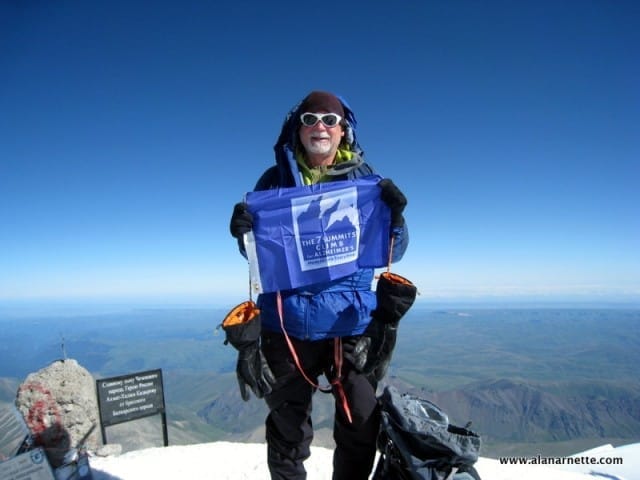
I am very pleased with a 6 minute documentary by the AARP on my Summits Climb for Alzheimer’s: Memories are Everything project. The producer, Lauren Cardillo, did a great job of taking my original pictures, videos and our live interview to tell the story of Ida Arnette, Alzheimer’s and my passion to make a difference. The film is scheduled to air on AARP’s television series, My Generation, hosted by Leeza Gibbons the week of September 16, 2012. My keynote presentations expand on the themes I discusses in the film. I want to remind anyone in the West Tennessee area that I will be speaking on behalf of the Pat Summit Foundation on October 7th. Also at Yale University Master Tea on September 27. As usual, I want to remind everyone that all donations go directly to your choice of Alzheimer’s organization to raise awareness, and research money; none ever to me. Climb On! Alan Memories are Everything
World Alzheimer’s Month
September is World Alzheimer’s Month, order an event designed to bring global attention to this devastating disease. September comes on the heels of my mom’s death from Alzheimer’s in August only three years ago. Last year I noted the event from the summit of Mt. Kilimanjaro in Africa as I was nearing the completion of “The 7 Summits Climb for Alzheimer’s: Memories are Everything” project. In the course of only 9 months, I climbed the highest mountain (including Everest) on each continent to send a message of hope, view need and urgency that Alzheimer’s is a disease with no cure and needs more public awareness, education and research funding. Of note, Alzheimer’s Disease (AD) is the only disease in the top ten with no disease-modifying ment or cure and kills more Americans each year than breast and cancer combined. I am continuing my work today with more climbs and public speaking. By the Numbers The cases of AD continues to grow at a staggering rate. In 2012, every 68 seconds (from 70 seconds) a new case is diagnosed in the US and a mere 4 seconds worldwide. The costs of caring for an individual is growing significantly and the toll on caregivers continues to be the silent story of the widespread devastation Alzheimer’s bring to families. It is not a good story. If you have followed me, you know these numbers, but they deserve repeating as they are shocking with over 5.4 Americans and 35 million worldwide having AD. The Alzheimer’s Association provides this insight: ? Every 68 seconds, someone in America develops Alzheimer’s disease;by mid-century someone will develop Alzheimer’s disease every 33 seconds. ? Alzheimer’s is the 6th leading cause of death in the United States. It is the 5th leading cause of death for those over the age of 65. ? People with Alzheimer’s and other dementias cost Medicaid 19 times more than older people without these conditions. ? 1 in 8 people age 65 and older has Alzheimer’s and nearly 1 in 2 over age 85 has it. ? 1 in 7 people diagnosed with Alzheimer’s disease live alone. Please re-read these facts and let them sink in, especially the last one. Disappointing Clinical Trials Over the summer of 2012, there was discouraging news on the drug front with three al trials yielding disappointing results. These results dashed the hopes of millions. That said, I want to preface the details with my belief that there are no “failures” in medical research, only lessons. These trials will yield lessons for research efforts for years to come. Two drugs, bapineuzumab and solanezumab, are categorized as disease modifying drugs or immunotherapies. They leverage the notion of using our own antibodies to clear or block the formation of brain plaques formed by buildup of amyloid-beta proteins that are signs of AD. Researchers focused on finding antibodies that can stick to amyloid-beta, with the idea that this could help people’s own immune systems dissolve plaques or prevent them from forming. The work performed by Janssen Alzheimer Immunotherapy R&D LLC (a joint effort of Johnson & Johnson and Pfizer), with the drug bapineuzumab failed to meet the objectives of their al trial. It had high hopes of slowing the progression of the amyloid proteins in individuals with the gene ApoE4 that suggested a predisposition for developing Alzheimer’s. There were several al trials involving individuals with, and individuals without, the gene; however the trials showed no benefit over placebos and was halted. Several thousand individuals participated in these lengthy trials. The trial used an intravenous form of application but it was reported that a Phase II study of a subcutaneous formulation of the drug would continue. read the press release and this one While a setback, I like this quote: “While we are disappointed in the results of the two bapineuzumab IV studies, particularly in light of the urgent need for new advancements in Alzheimer’s disease, we believe that targeting and clearing beta amyloid remains a promising path to potential al benefits for people suffering from this disease,” said Husseini K. Manji, M.D., Global Therapeutic Area Head for Neuroscience, Janssen Research & Development, LLC. “Janssen remains strongly committed to tackling the enormous unmet medical needs in Alzheimer’s disease. We believe the trial results will provide a rich data set that will advance our understanding of this complex disease and inform future research in this field. Studies with other compounds in earlier stages of development in the AIP portfolio are continuing and future development strategies will be discussed jointly by the alliance partners.” The other trial that had a high public profile was from Eli Lilly with a drug called solanezumab. It also attacked AD from the amyloid angle but proved not to slow the progression either. This al trial involved more than 2000 s. However, when the data from the Lilly trial was sliced in a different way, there were some signs of encouragement that it might be helpful in s with mild symptoms but not those with the moderate disease. A different al trial will continue as planned and Lilly stated their belief that the “amyloid hypothesis” remains valid. read the press release One thought on why these approaches did not meet expectations is due to an increasing understanding that AD begins much earlier than was once believed, perhaps 20 or 30 years before symptoms appear to family or even physicians. Thus by starting ment even at the first sign, it may be too late to slow the progression. The Research Continues Technology Review reports that Genentech’s upcoming study of creneuzumab, another anti-amyloid antibody, will test the drug on about 300 people with a genetic mutation that nearly guarantees they will develop Alzheimer’s. Participants will receive the drug while they are still healthy, making the study the first large-scale effort to learn if antibodies can actually prevent the disease as opposed to slowing the progression. Meanwhile, the Wall Street Journal reports that other efforts continue: Baxter International expects late-stage, or Phase 3, al
Every 4 seconds, a New Case of Dementia in the World
Dementia and Alzheimer’s a Global Health Priority This is from a new study from the World Health Organization, drugstore WHO, click that today declared Dementia and it’s most common form Alzheimer’s a global health crisis. Hopefully this will rally efforts around the world to find improved early detection, ments and a cure. Worldwide, nearly 35.6 million people live with dementia. This number is expected to double by 2030 (65.7 million) and more than triple by 2050 (115.4 million). Dementia affects people in all countries, with more than half (58%) living in low- and middle-income countries. By 2050, this is likely to rise to more than 70%. This the entire release from Alzheimer’s Disease International: WORLD HEALTH ORGANIZATION AND ALZHEIMER’S DISEASE INTERNATIONAL SAY DEMENTIA MUST BE A GLOBAL HEALTH PRIORITY New Report Calls on Nations to Recognise Dementia as a Public Health Crisis Geneva, April 11, 2012 – A report released today by the World Health Organization (WHO) and Alzheimer’s Disease International (ADI) calls upon governments, policymakers and other stakeholders to make dementia a global public health priority. This new report provides the most authoritative overview of the impact of dementia worldwide. In addition to valuable practices and practical case studies from around the world, it contains the most comprehensive collection of data, including hard-to-get statistics from low- and middle-income countries, thereby dramatically underscoring that this is truly a global problem and not just a “disease of the industrial world.” To prepare the report, titled “Dementia: A Public Health Priority,” WHO and ADI commissioned reports from four working groups of experts and sought additional inputs from nearly two dozen international contributors and more than 20 expert reviewers. The project leaders were Dr. Shekhar Saxena, Director, Department of Mental Health and Substance Abuse, WHO; Marc Wortmann, Executive Director, ADI; Dr. Daisy Acosta, Chairman, ADI; Prof. Martin Prince, Institute of Psychiatry, King’s College London; and Ennapadam. S Krishnamoorthy, Director and T.S. Srinivasan, Chair, The Institute of Neurological Sciences, India. “WHO recognises the size and complexity of the dementia challenge and urges countries to view dementia as a critical public health priority,” said Dr. Saxena. “Right now, only eight of 194 WHO member states have a national dementia plan in place, and a few more are in development. Our hope is that other countries will follow suit, using this report as a starting point for planning and implementation. A few, like India, have national strategies developed by civil-society organisations, and we hope this report will prompt their governments to adapt these into official national plans. Since we know the prevalence of the disease will explode in this century as we all live longer – the risk of dementia is 1 in 8 for those over 65 and a shocking 1 in 2.5 for those over 85 – its impact will become greater as the decades go by.” In her foreword to the report, WHO Director-General Dr. Margaret Chan called the report “a major contribution to our understanding of dementia and its impact on individuals, families and society.” She said the report “provides the knowledge base for a global and national response to facilitate governments, policymakers and other stakeholders to address the impact of dementia as an increasing threat to global health.” Dr. Chan called upon all stakeholders to “make health and social care systems informed and responsive to this impending threat.” Marc Wortmann of ADI underscored the urgency of action: “With its devastating impact on people with dementia, their families, their communities and national health systems, dementia represents not only a public health crisis but a social and fiscal nightmare as well. Around the world a new case of dementia arises every four seconds. That’s a staggering growth rate, equivalent to 7.7 million new cases of dementia every year – the same size as the populations of Switzerland and Israel. Our current health systems simply cannot cope with the explosion of the dementia crisis as we all live longer; this is as much an economic and fiscal disaster waiting to happen as it is a social and health challenge of the highest order. However, the report also shows that there is a lot that can be done to improve the lives of people with dementia and their carers. The entire dementia community, and indeed the world, owes a huge debt of gratitude to the WHO to have taken the leadership in the creation of the report. The WHO is the singular organisation globally capable of such a critical role in matters of public health.” Publication of the WHO/ADI report comes on the heels of an impassioned plea for action by global public health expert Prof. Peter Piot who, as former UNAIDS Executive Director, helped lead the world in turning HIV/AIDS from a certain death sentence into a manageable illness. In a recent speech, Prof. Piot described dementia – and Alzheimer’s disease in particular – as a “ticking time bomb” given the rapid growth in aging populations worldwide. According to ADI research, now given even further legitimacy in the WHO’s report, the number of people living with dementia worldwide, estimated at 35.6 million in 2010, is set to nearly double every 20 years, reaching 65.7 million in 2030 and 115.4 million in 2050. Drawing striking parallels between dementia today and HIV/AIDS in the 1980s, Prof. Piot argued that the world must tackle dementia with a similar level of urgency and concerted resources. “If the world needed a wake-up call, it is on this global crisis. I do not see any alternative than to Alzheimer’s with at least the attention we gave HIV/AIDs,” said Piot. “Given these numbers,” said Michael Hodin, Ph.D., Executive Director of the Global Coalition on Aging and Senior Fellow at the Council on Foreign Relations, “Alzheimer’s, among all non-communicable diseases, demands our urgent and serious focus. We must find the political will and accompanying funding for more effective ments, earlier detection and , and most critically prevention and cures. Absent this level and scope of attention, Alzheimer’s will surely become the
Alzheimer’s Tsunami Growing at Alarming Rate
The Alzheimer’s Association’s annual look at the prevalence of the disease and impact has resulted in startling numbers for 2012. The Mayo Clinic defines AD as: Alzheimer’s disease causes brain changes that gradually get worse. It’s the most common cause of dementia — a group of brain disorders that cause progressive loss of intellectual and social skills, severe enough to interfere with day-to-day life. In Alzheimer’s disease, brain cells degenerate and die, causing a steady decline in memory and mental function. 5.4 million Americans are living with Alzheimer’s disease. One in eight older Americans has Alzheimer’s disease. Alzheimer’s disease is the sixth-leading cause of death in the United States and the only cause of death among the top 10 in the United States that cannot be prevented, cured or even slowed. More than 15 million Americans provide unpaid care valued at $210 billion for persons with Alzheimer’s and other dementias. Payments for care are estimated to be $200 billion in the United States in 2012. 2012 Political Influence USAgainstAlzheimer’s is a national advocacy campaign and independent advocacy network committed to stopping Alzheimer’s by 2020. They work to advance policies to prevent, and cure Alzheimer’s disease in our lifetime. Visit their site to see the 2012 political candidates positions on Alzheimer’s. Please join me in learning about this disease and making a difference through advocacy, education and funding. Climb On! Alan Memories are Everything
Alzheimer’s Funding Progress and a Moving Video
Progress continues in funding the war against Alzheimer’s. The Obama administration, through the Health and Human Services Department, will immediately reallocate $50 million in research funds this year (2012) and will request an additional $80 million in its fiscal 2013 budget. This represent a 25% increase over the current annual investment in Alzheimer’s. A tremendous amount of credit goes to Senator Susan M. Collins (R – Maine), Senator Mark Warner (D-Virginia), Congressman Ed Markey (D-Massachusetts), Congressman Chris Smith (R-New Jersey); all co-sponsors of various Alzheimer’s legislation. Another encouraging step was contained in the meeting notes from the January advisory council on Alzheimer’s research, care and services as required under the National Alzheimer’s Project Act (NAPA). This act requires the department of Health and Human Services to create a strategic plan for the federal government’s role in fighting Alzheimer’s disease. This puts Alzheimer’s on a similar path taken by the Government for AIDS and cancer. I was pleased to see these elements highlighted for further consideration: Financial relief, such as tax rebates, for families who are paying out-of-pocket for their loved ones’ care. Launch a public awareness campaign that promotes awareness and early detection, with special focus on diverse communities and populations (e.g., younger-onset, persons with intellectual disabilities). Launch an additional campaign on early detection targeted at educating health care professionals. Redesign Medicare coverage and physician reimbursement to encourage and to provide care planning for diagnosed individuals and their caregivers. The meting notes are well presented and give insight to how NAPA is addressing the growing crisis. The battle continues with exciting announcements coming almost daily. While encouraging, we must keep in mind a cure is still far away and every announcement involving a new idea or test case in animals still requires years of human testing before we know if it works. You can see the current al trials at the National Institute on Aging’s site. As I have said many times, with the devastation this disease brings to individuals, finances and families; Alzheimer’s must take center stage in healthcare. And we must never give up hope. Finally, I wanted to share this outstanding video created by Richard Roman and Jenna Pothoff. Please visit their site for their full story. Climb On! Alan Memories are Everything