Another Death in the Karakorum

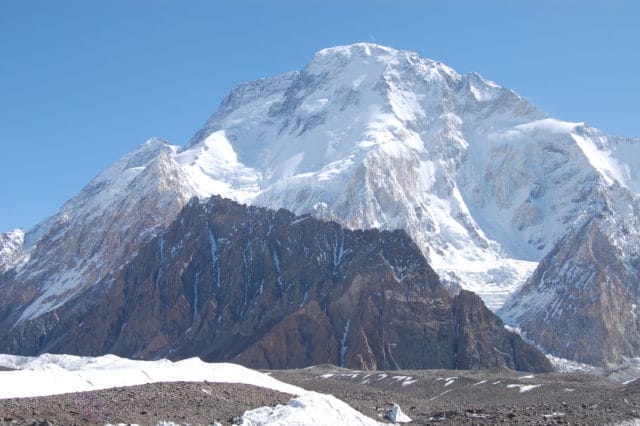
Tragic news from the team attempting Broad Peak this winter. The body of Alex Goldfarb has been found on the nearby trekking peak, Pastore Peak. 

Potential Broad Peak Tragedy

After the first winter K2 summit and the tragic death of Sergi Mingote on K2, now there is a developing situation on Broad Peak.

Mingma Sherpa Continues 8000er Roll with Broad Peak
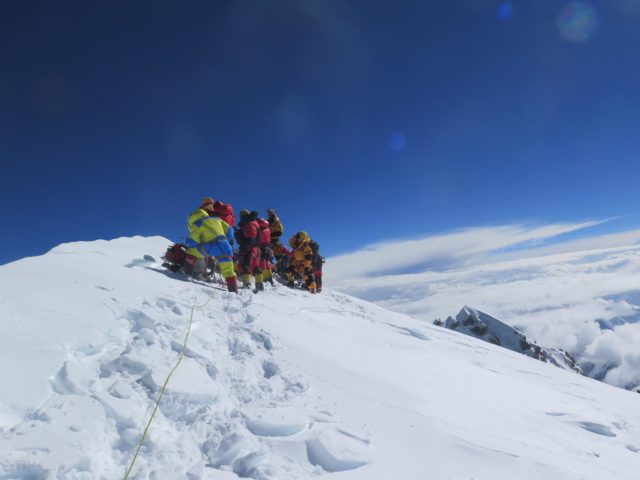
Mingma Gyalje Sherpa on K2 in 2017

Mingma Gyalje Sherpa founder of Dreamers Destination continues his impressive 2017 with yet another summit of an 8000 meter mountain, Broad Peak. Icelander John Snorri Sigurjónsson also summited BP adding to his two 8000ers this year – K2 and Lhotse. British-American Vanessa O’Brien who summited K2 with Mingma was not with them but apparently, as reported by Mingma, Fredrik Sträng went along to nab Broad Peak thus not wasting his trip to the Karakorum after not being able to summit K2. Mingma posted on Facebook: Finished my 11x8000m peak. Broad peak is my 10th 8000m without oxygen. All safely arrived back to camp3. Congratulation to all my team member. John Snorri became first Icelandic, Ali Reza made twice(on 27july and 4aug), Dawa Gyalje Sherpa, Tsering pemba sherpa completed 11x8000m, Mingma nuru sherpa, Ngima norbu sherpa( both k2 and broad peak without oxygen) Liu yong zhong completed 11x8000m and Dong hongjuan completed her 10th 8000m. Fedrick from Sweden also made it but he is not part of our expedition. Summit videos will be posted tomorrow. Thanks for following us. This is the 31 year-old Mingma’s fourth 8000er summit in 2017: Dhaulagiri on 30 April, Makalu on 14 May, K2 on 29 July and Broad Peak on 5 August. He came very close on Nanga Parbat but said he believes he mistakenly stood on a sub summit and will have to go back. He has summited 11 of the 14 8000 meter mountains. Mingma Gyalje Sherpa on K2 in 2017   Sherpa Success on 8000ers The world’s highest peaks used to be the domain of climbers from Italy, Spain, and the like but in recent years, Sherpas from the Makalu and Rolwaling have taken on the big peaks and are knocking them off in quick fashion. Nationalities of climbers who have completed all 14 of the 8000 meter mountains. Italian – 7 Spanish – 6 Kazakhstani – 3 Korean – 5 Polish – 3 Nepali – 2 Australian – 1 Austrian – 1 Czech – 1 Ecuadorian – 1 Finish – 1 German – 1 Iranian – 1 Slovenian/Italian – 1 Japanese –  1 Mexican – 1 Portuguese – 1 Slovak -1 Swiss – 1 American – 1 Funded by low climbing permit fees in Nepal along with guiding western members, they have been able to summit multiple 8000ers each year when it used to take many years, if not decades, to accomplish this coveted mark in mountaineering. Reinhold Messner took 16 years, 1970-1986, to summit all 14 whereas Irian Azim Gheychisaz took nine years from 2008 to 2017. Leveraging Success Chhang Dawa Sherpa and Mingma Sherpa set the Sherpa standard when they summited all 14 and started the guiding company Seven Summits Treks aka 7S. Today 7S has emerged as one of the largest Nepali guide companies with close to 100 members each season on Everest alone. Dawa set the age record as the youngest climber to summit all 14. His last 8000er was Dhaulagiri in 2014 at age 32. He and his brother were born in the Makalu region, not the Khumbu, thus putting their region on the climbing map. Today many Sherpas on Everest are from Makalu and Rolwaling. Well Earned Praise Sincere congratulations to Mingma, John and Ngima Norbu Sherpa for summiting both K2 and Broad Peak with the rare double summit Also to Pakistani Ali Reza on topping out on Broad Peak twice this season and Tsering Pemba Sherpa and Mingma Nuru Sherpa for summiting K2 and Broad without supplemental oxygen – impressive. Finally, I want to point out that Mingma Gyalje Sherpa did use supplemental oxygen on K2. I am very impressed with his decision as he is clearly capable of summiting without but choose to use Os given he was guiding members. Climb On! Alan Memories are Everything

K2 summer Climbs and more

After a tragic Everest season,  many climbers will continue their quest to summit the world’s highest mountains by moving to Pakistan. The Karakorum Range holds five of the 14 mountains higher than 8000 meters aka the 8s. Raheel Adan does a great job of covering Pakistan and just published a list of the expeditions on his website K2,  as always, draws the most attention and rightfully so. This year, two companies are leading commercial teams there which might be considered a milestone in mountaineering. Of note, I don’t believe K2 will become the “next Everest” for commercial guides as I explain later. K2 2014 was a banner year for the “Savage Mountain” with 40 summits, including myself who became the 18th and oldest American to summit K2. It is the world’s second highest at 8611 m, 28,251 feet. Many have speculated that K2 was about to become the “new Everest” with summits by people like myself 🙂 I addressed this in one of my post K2 blogs but in summary. I don’t think K2 will become Everest due to the low success rate of summits, high death rates and skill required from the climbers. I said in my post: With K2 being my 36th major expedition including four on Everest, my honest assessment is that K2 is not Everest. As anyone who has read my blog for the past decade can attest, I have utmost respect for Everest and her climbers. It is the highest mountain in the world after all! But K2 is totally different. While K2 is lower than Everest by about 800 feet, the climbing presents an entirely different level of difficulty, complexity and needs for skills. Each climber must has proven, long term skills in rock, ice, snow. Falter on one, you gamble with your life. The fixed ropes are mostly a placebo, some showing the route but others not strong enough to stop a fall. You actually rock climb using hands and feet, look for hand holds, literally use your upper body to ascend using a jumar. You use the front points of your crampons, not for traction on a snow slope, but to secure your body to a vertical ice or rock wall. It is a game of tiny edges, of inches. Your body is supported by your feet, your hands prevent you from falling backwards. If you slip on loose rocks and are not properly secured, you will fall and die. There is no recovery opportunity. Climb K2 is about as serious as one can get and at severe altitude. And the decent is in some ways worse. You must rig rappels (or abseil) over and over, each one must be perfect, there is zero room for error. There is a maze of old ropes on K2 that need to be cleaned up. If you choose the wrong rope, and you slip thus weighting the rope, it will break under your weight. You are exhausted, the lack mental focus is very real so mistakes are easy and often. No one can climb for you, you are on your own, totally responsible for yourself; no guide, sherpa, teammates or porter can climb for you. You must be constantly on the outlook for large, as in microwave size, falling rocks that can kill you instantly. Avalanches are a constant threat. And the weather … In both 2012 and 2014, the weather made K2 “easier” We had a solid week of low winds and light precipitation that greatly reduced the risks. That said, those on the first summit push on July 26 came extremely close to getting frostbite and stopping their attempt as they waited for the lines to be fixed across the Traverse. Many are lucky they did not loose fingers, toes or worse – this will be underreported in my experience. One person did die. Spaniard, Miguel Angel Perez Alnarez, died at Camp 4 after two summit pushes. Everyone watched the situation unfold and stayed in radio contact with him but he was climbing solo and at first without supplemental oxygen. Rescue teams were sent to give aid as soon as he called for help but they were too late. It takes at least two days to reach him from base camp, helicopter impossible at 8000m. It is a tragic situation and I want to extend my deep condolences to his family and friends. But this situation highlights how dangerous any 8000m mountain can be in good or bad weather. This year, 2015, two companies are leading commercial climbs: Madison Mountaineering with 5 members and Himalayan Experience with 12. Both will be supported with a 1:1 ratio of Sherpas to members plus Pakistan High Altitude Porters (HAPs). Russell Brice hand picked his team based on previous expeditions. One member with a lot of high altitude experience is David Tait, who has summited Everest five times, all with Brice, and completed a traverse from North to South on the Big E. Vanessa O’brein, who has the female speed record for the Adventure Grand Slam (7 Summits plus North and South Poles) is climbing with Garrett Madison. In addition, Pakistan operators including Nazir Expeditions and Adventure Tours Pakistan will be fielding their own teams usually made up of individuals working together with little on-mountain support. Nepal operator Seven Summits Treks, is also schedule to provide logistics for a disparate team in 2015. We were lucky with the weather last year in that 3 of the previous 5 years saw no summits due to bad weather. We will see what 2015 holds for these teams. I don’t expect the earthquakes in Nepal to be a factor in the Karakorum this year. Broad Peak Sitting about a mile way from K2 is Broad Peak, the world’s 12th highest mountain at 8047 m, 26,414 feet. Many people try to use Broad as an acclimatization climb prior to K2 but few accomplish this double. In 2015, Bulgarian Boyan Petrov did just that. I met him on the way up

Climbing News: Deaths on Broad Peak, Naga Parbat

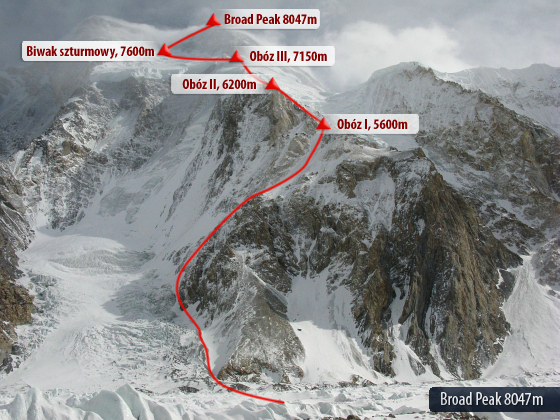
The winter of 2013 has come with strong summits, valiant efforts and unfortunate deaths. Climbing in the winter is dangerous at and deadly in many cases. A coveted summit is one of the fourteen 8, 000m mountains. As of this winter, only K2 and Nanga Parbat remain to be summited in the winter in spite of repeated efforts. Broad Peak Broad Peak sitting in the shadow of K2 is 26,414 feet (8051 meters) is in Pakistan and has a deceptive reputation as one of the “easier” 8000m mountains. It is not, especially in the winter. The Polish team of Maciej Berbeka, Adam Bielecki, Tomasz Kowalski and Artur Ma?ek stuck out harsh weather to successfully summit on March 5. Sadly, two of the team,  Berbeka (58) and Kowalski (27), became separated from their teammates while descending extremely slowly.  Berbeka was sighted through a telescope at the saddle and reported to have made the normal 1 hour descent from the summit to the saddle in over 7 hours. He is thought to have fallen into a crevasse. Expedition leader, Krzysztof Wielicki, said “Tomasz didn’t make it to the pass. He stayed on the Chinese side. It’s been 30 hours that he’s been there and he won’t be coming down. He was already weak. He wasn’t able to push on. For hours, I kept pushing him (via telephone) to move on but he was no longer capable of doing so.” Once missing, for the next 48 hours, the entire team searched the route both in person and with telescopes from base camp without success. Night temperatures were approaching -35C (-31F) and the climbers had no shelter or sleeping bags. Helicopters were not available to search at these altitudes and also due to weather. On Friday, March 7, a big storm moved in discouraging the team. The expedition leader, Krzysztof Wielicki, said Thursday there are “no chances at all” of finding them alive. I recall my own climb on Broad Peak in 2006 (no summit). It is an unforgivingly steep climb with extreme winds and strong snow storms. The lower section of BP is steep then transitioning to a heavily crevassed section just below a saddle that leads to the summit ridge. There is a false summit before a treacherous, narrow and exposed section to the true summit. It takes extremely strong climbers to reach the true summit. The Polish team had made an earlier attempt to summit a few weeks ago reaching 7820m (25,656 ft) before bad weather stopped them. This is such a sad ending for the Polish climbing community. They have set the standard for winter mountaineering in the Himalayas and have been the first on 10 of the 14 8,000m peaks in winter. My deep condolences on this loss and also a sincere congratulations on achieving the first summit of Broad Peak in the winter. Update March 8, 2013: Krzysztof Wielicki, leader of the winter expedition of Polish Mountaineering Association to Broad Peak just posted this official statement: Considering all the circumstances, conditions, my experience, history of Himalayan mountaineering, knowledge regarding physiology and high-altitude medicine as well as consultations with doctors and co-organizers of the expedition in Poland, I have to declare Maciej Berbeka and Tomasz Kowalski dead. Taking into account the time that has passed since the last contact, altitude where it took place, their condition, current weather conditions and all other factors, I have to claim openly that both climbers are dead. The expedition has come to an end. We are packing the base camp and start to descend. March via the Baltoro Glacier will take approximately 5 days. We will come back to Poland on approximately 20th March.  Nanga Parbart Nanga Parbat is 26,600 foot, 8126 meter mountain, also located in Pakistan and known as one of the most difficult in the world. A Hungarian/US team of David Klein (Hungarian), Zoltan Acs (Hungarian), and Ian Overton (American) attempted to be the first to summit Nanga Parbat in the winter. They did not use porters, Sherpas or supplemental oxygen. Poor weather forced them to abandoned their effort as did the Itialian-French team of Daniele Nardi and Elisabeth Revol on the unclimbed Mummery Face. French snowboarder Joel Wischnewski was attempting to solo snowboard the Rupal face on Nanga Parbat. Sadly he disappeared without a trace. Denali For the third time Lonnie Dupre attempted a solo ascent of Mt. McKinley aka Denali in the winter. This year, he topped out at the 17,200 foot High Camp only to find hard packed snow and threatening conditions. This conspired to prevent him from making a suitable snow cave to rest up before his summit bid. He abandoned his bid soon after. He had spent 19 days on the mountain. There have only been two December or January summits of McKinley but no one has done it alone. There were two other climbers this year, Japanese Masatoshi Kuriaki, aka the Japanese Caribou attempting a winter solo climb on Mt. Hunter and Japanese photographer, Norio Matsumoto, looking for that perfect shot of the aurora. Kuriaki was back at the landing strip with Lonnie at end of January. Ang Nima Sherpa The Everest family lost one of their long time Sherpas with the death of Ang Nima Sherpa. He was one of the longest serving Ice fall doctors. He was 59 and died in his home village of Pangboche on January 25, 2013. The Ice fall Doctors are a small team of Sherpas who set the route each year in the Khumbu Ice Fall and Western Cwm. They carry the aluminum ladders, ropes, pickets, wands and ice screws on their backs into the icy labyrinth only to return almost every day to reset the route as the ice moves up to three feet a day. They repeat this ritual each year given the constant movement of the ice. I took the attached picture in 2008 of the Doctors heading into the Icefall. These guys work hard and play hard and without them, climbers would not stand a chance of summiting each year. Thanks to Ang