Everest 2018: EBC Filling Up
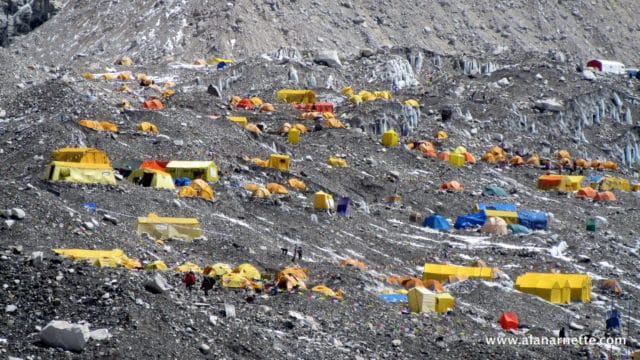
Activity is increasing as we approach mid April. Several teams have crossed the border with China heading for Chinese Base Camp (CBC) and many others are already at Everest Base Camp (EBC) on the Nepal side. There have been the normal annoyances but nothing major. One of the Icefall Doctors was hurt in the Icefall but not seriously. Tibet, South, China, Nepal, North??? Terminology can be a bit confusing so let me lay out how I talk about both sides of Everest. As you know, Everest is climbed the vast majority of the time from the North side aka Tibet aka China via the Northeast Ridge aka North Col or from the South side aka Nepal and take the Southeast Ridge aka South Col. Click on the links to see maps and more details about these routes. Usually teams arrive at their respective base camps around mid April, so we are right on schedule the year. Regardless of side, teams spend about 40 days on expedition. Looking at which side has more success, defined by putting at least one member on the top using one of the two standard routes, 439 out of 734 Tibet side teams were successful or 60% compared to 66% on the south or 656 out of 992 expeditions since 1950. For those who didn’t succeed, poor weather was the number one reason. Of note, looking at the success rates from 2003 to 2013 to eliminate skewing the result by two years with no summits in 2014 and 2015, the Tibet side increased their success rate to 67% while on the Nepal side, it greatly improved to 78%. But just to show how statistics can be misleading, last year, 2017, Tibet enjoyed an 81% result while Nepal dropped to 68%. A lot of this can be attributed to weather, the experince of the teams and a million other factors! Sherpas in the Cwm IMG is getting a jump on the other teams. Greg Vernovage noted that 34 IMG Sherpa left Everest Base Camp between 2:45am and 3:30am Thursday morning. The Sherpa team went through the Icefall and arrived at Camp 1 by 6am. They reported the Icefall was in excellent condition. “The best we have seen it in a long time.” Also Mingma Sherpa with a Chinese team and one Canadian, said “today our 11 Sherpa made it to camp 1 and all returned back. The route to camp 1 is best so far. They used to experience ladders in more than 20 places but this year it is only in 3 different places with two ladders joined maximum. But it is expected to have at least 9 ladders joined to cross a big crevasse between camp 1 and camp 2.” Chinese Base Camp Multiple teams have crossed the border into China including Arnold Coster with Seven Summits Treks and Summit Climb. I can tell you from first hand experience that this crossing is “different” at best. The officials have zero expressions, give zero feedback and once you are “cleared” you have no idea what you did right or wrong. For many years, if not decades, climbers entering China to climb in Tibet made the border crossing at Zhangmu but the town and road suffered major damage in the 2015 earthquake and has been closed until recently. Now the Chinese have opened the crossing at Kyirong (sometimes spelled Gyirong or Kyidrong) to foreigners. It’s about 60 miles west of Zhangmu on a paved road that goes all the way to Lhasa. Teams will take this road and spend several nights along the way acclimatizing. 7 Summits Club have established their luxury base camp. Each member will have their own “2-room Cabana”. Cho Oyu Rolfe Oostra at 360 Expeditions is on Cho Oyu and made this interesting post: Back and forth to various meetings today to establish some facts about climbing Cho Oyu this season. Climbing in Tibet is never as straight-forward as Nepal and there are endless surprises which only this place could generate. Take Sheena’s passport photo for example; yesterday a mini-emergency arose when I was told that Sheena’s passport photo was in-adequate to be used for her visa application. When I found her, she produced another which was exactly the same and since we didn’t have time to get to a photo booth I gave my fixer this copy. He came back today saying that this photo was perfect. Apart from mini-mysteries such as this I have discovered from the Tibetan Mountaineering Council that there are only 19 foreign climbers attempting Cho Oyu this spring. There will be a total of 7 climbing Sherpas and 1 foreign guide (me) working on the mountain this season. Many of the climbers this year will be without Sherpa or guide support but they will be using the fixed line put up by both the 360 and Kobler teams. We will bring more than 1 kilometre of rope and so will the Kobler team of 4 foreign climbers and 3 climbing Sherpas. Team 360 has two climbing Sherpa’s who are Himalayan veterans and who I will introduce to you in a following post. Personally, I love the fact that so few climbers will be around. Everyone it seems is on Everest. Before us lays a mountain as pristine as found by the first ascensionist and only a small handful of people who have to work closely together to find a way to the top. When all the teams finally get to basecamp the atmosphere is bound to be akin to one found in a tiny mountain hamlet as compared to the Megalopolis that is Everest basecamp each year. Wow! Can’t wait, now if only those bureaucrats would hurry those damn visa’s along… In the department of rush as fast as you can to reach the summit and get back home to work, Alpenglow promotes “Which mountain would you rather climb? Cho Oyu (26,906 ft) vs. Everest (29,029 ft). A select group of Alpenglow climbers will attempt to summit both mountains in under 30
Everest 2018: First Teams at Base Camp with new Rules

The flood of climbers continues to arrive in Kathmandu, trekking to base camp or crossing the border into China. The weather is decent and no serious issues have been reported thus far. 2018 like 2017 Nepal’s Ministry of Tourism has released a few numbers: Everest teams: 29 Everest foreign permits: 275 (thus far) Everest Sherpas: 275 (thus far) They expect to issue a similar number of permits as in 2017 which was 366 foreign climbers on 43 teams. According to Nepal Government numbers, 190 foreigners summited along with 32 fee-paying Nepalis and 223 Sherpas made the summit from the Nepal side last year. Another 100 foreign permits have been issued for other Nepal mountains this year including Dhaulagiri, Kanchenjunga, Makalu and Ama Dablam. I am expecting over 400 total summits on the Nepal side and 200 on the Tibet side for 2018. Rules and Screening Dinesh Bhattarai, chief at the Tourism Department that issues climbing permits, told the Kathmandu Post that there has been lack of oversight over expeditions causing controversy and tragedy and “We learned many lessons from the last season. We don’t want to repeat those mistakes,” He went on to repeat the same list of new rules previously published that will make #Everest2018 safer, in his view. They included: Team leaders, climbers, high-altitude climbing guides, government appointed liaison officers and agencies handling the expedition are required to follow new rules strictly The Tourism Department will verify the health certificates of the climbers more rigorously. Liaison officers we will have their locations strictly monitored. They have to wait at the base camp until the expedition is completed and act as a regulator so that controversies on Everest are minimized Each climber must have at least five oxygen cylinders each The government has also strictly prohibited disseminating controversial messages or broadcasts without prior approval. On this last item, this is similar to what Nepal tried to do in 2008 when the Chinese closed the north side for the Olympic torch ceremony on the summit. They were fearing protests over Tibet. Climbers were told to sign an agreement that required all communications – written and verbal – to be cleared through a liaison officer (who wasn’t there). As you can imagine, nothing was really enforced. But then an American climber posted an offensive sign on his tent at Camp 1. I was there in 2008 was remember being told that all sat phones would be confiscated and could only be used under the supervision of a Nepali/Chinese solider. They actually came around and took our phones. We had to go to the army camp and request to make a call while an armed guard stood by listening to the conversation. This lasted for only a few days. This year’s rules seem to revolve around a report last year in the Himalayan Times that Sherpas found 4 dead bodies in a tent at the South Col – it was incorrect but went viral creating embarrassment for Nepal and hurting the finely tuned safety reputation that they try to manage. He also mentioned the report that the Hillary Step had collapsed, apparently believing that telling the world that an earthquake might have altered the landscape would hurt business. Bhattarai commented on this new screening rule that only applies to “controversial issues” and “Our intention is not to stop the dissemination of news. However, for some controversial issues, prior approval should be obtained from the government.” My sources tell me that expedition leaders have been asked to sign a contract but that social media posts are excluded from any scrutiny. One final comment on these rules – climbers are required to use oxygen? This is the first I have seen this specific rule of a minimum of 5 bottles each. I guess someone could buy the bottles and not use them but this seems at odds with the spirit of mountaineering. If Nepal goes too far with some of these rules, they risk cutting off the hand that feeds them. A Helping Hand Mike Hamill made a good post as his Climbing the Seven Summits, aka CTSS, team continues to trek to base camp on the Nepal side. Anyone who has trekked to Everest Base Camp might have stopped in Pheriche and visited the The Himalayan Rescue Association. This organization cares for locals and visitors alike mostly on altitude related issue and works closely with EverestEr at base camp. Mike fills us in on a bit of the history: We popped over to the HRA (The Himalayan Rescue Association) this afternoon for their daily briefly about how our bodies react to altitude and how to respond to any signs and symptoms.The HRA is a voluntary non profit high altitude medical clinic. Major credit goes to Dr. John Skow, an American national, who in 1973 went up to the Khumbu and was distressed that many people were dying from Acute Mountain Sickness. He felt that something ought to be done about it. He called together a meeting of officials from the Ministry of Health, some doctors and few other individuals from trekking companies. Another meeting followed with more clear ideas about what to do. The persons from the trekking companies also realized that since it was their members who were affected most should take the initiative. Finally in the third meeting it was decided to form Himalayan Rescue Association Nepal with most of the trekking agencies contributing generously in its early days. They set up some remote medical outposts, including here in Pheriche and there is also an HRA at Base Camp. The HRA have been an integral and critical part of Everest mountain life ever since. We can’t speak highly enough of them and the doctors who volunteer their time. The clinic runs on donations, small fees and merchandise sales. A Market for Luxury As I reported last month, Seven Summits Treks who is best known for low cost Everest climbs is using their market presence to cater to the ultra high-end market as well. Their VVIP
Everest 2018: The Critics Corner
I’ve been covering Everest since 2002 and each year about this time in my coverage I get the usual comments decrying the commercialism, the tourism, the lack of skills by the climbers, the lack of challenge and more. Usually I ignore the comments and in rash cases delete them when they become personal or simply irrational, of course in my humble opinion. 🙂 After all, this blog is about celebrating the challenge of mountaineering, not a platform for those with agendas to put down others by their artificial definitions of what is a “good” climb. I fully accept and respect the sense of climbing by “fair means” or unique, difficult routes and first ascents – they are to be celebrated without question. However for most climbers, the only rules that really matter are those around their own person goals. To see if they can do it. To see if they are who they think they are. To learn and return home a better version of themselves. This is what climbing is all about for me. The summit (or just the attempt), with or without oxygen, ropes or Sherpa support is secondary and does not take away from an individual’s personal achievement, as measured by that person alone and no other. The Other Side I have defended Everest climbers, and myself, since 2002. I have seen and heard it all. While I agree with some criticism, especially around those climbers with limited experience and those “guides” who take money with inadequate experience; overall an attempt of Everest is a moment in a person’s life to be supported and admired. I will dispute that anyone is “hauled to the summit.” I could go on and on as I did in the article I wrote for Rock and Ice in 2013 but I won’t. I will simply quote Chris Bonington in a recent publication in the by invitation only Explorer’s Club Explorers Journal. If you don’t know Chris, do some homework. If you don’t know Chris, you may want to to reconsider your criticism. Here’s Chris. EJ: What do you think of the way Everest is climbed today? CB: Well, I’m incredibly glad that I did it when I did, because we had the place to ourselves. So far as what’s happened since, I don’t blame the Nepalese government for opening up the mountain and basically saying that any number of expeditions can go up it. This has created the opportunity for guided and commercial climbing. Now you have a thousand people at basecamp and a hundred on the South Col, where there are fixed ropes that go all the way to the summit. But I don’t begrudge or regret what happened. It’s a natural evolution. Crowds of people have been guided up on Mont Blanc or the Matterhorn in the Alps for more than a century now. What’s happening on Everest is the same. But for each of these people going up today on fixed ropes it is still the experience of a lifetime. I just think that the experience could be made better. But I’m not worried about it. Climbing is an adventure and adventure is alive and well. Climb On! Alan Memories are Everything
Everest 2018: Week Two Begins
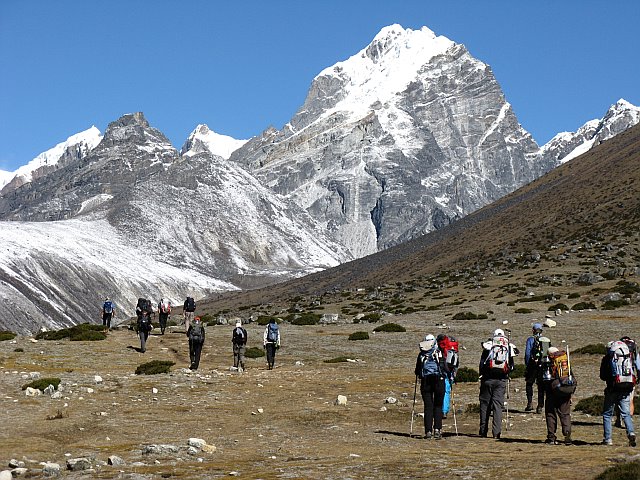
This week starts like last week – teams trekking or driving to base camp. So far, the season has no big surprises, just what we like this early. There has been a bit more precipitation than normal, but that could be, um, well it could just be the weather 🙂 Lobuche As the #Everest2018 season continues, some teams are doing a first round of acclimatization on nearby Lobuche East. This is known as a “trekking peak” but is still 6,119 m/20,075 ft. A few teams will actually camp out on the small area at the east summit. Almost no one will make the final climb to the true summit as it is heavily corniced and this is about acclimating so not worth the risk. But there are amazing views of Everest no matter where you stop. Camps in the Cwm Teams at EBC are beginning to establish camps in the Western Cwm. Sherpas tried to go up today, Monday 9 April 2018 but were stopped by a small collapse of ladders crossing a crevasse near the Football Field. The crevasse is quite wide and will require four ladders lashed together to cross it. More work for the Icefall Doctors. This is quite usual, especially early in the season but will be a common occurrence throughout depending on how stable the ice is around the route. Blessings Meanwhile, the Adventure Consultants team were blessed by the new Lama in Pangboche. As you know, Lama Geshe, who has blessed thousands, recently passed away and Lama Ngawang Paljor is now performing the ceremonies. They described his style as very different than the always smiling and laughing, easy going Lama Geshe: We entered a small well lit, would-be very sunny (if it wasn’t all grey cloud) room where every inch of every wall and ceiling space was covered in colourful Bhuddist painting. If it wasn’t painted dragons, doves, fruit, flowers, clouds, sea-shells, concentric circles, more flowers, and carved and painted “borders” then it was individual glass cabinets with small statues of a variety of bhuddas (also colourful including a big blue bhudda!). Right up my alley, and lots to admire. Although the Lama Ngawang Paljor didn’t smile a whole lot he certainly gave us an elegant and very genuine blessing. He prayed and blessed us with the passion of a professional caring for our bodily and spiritual well-being. We departed with Shrundi strings around our necks to wear for the expedition duration, also blessed to help keep us safe. More Climbers to Watch I keep adding, what I think, are somewhat unique climbs this spring season on Everest. One common factor in both of these stories is that some might consider them “disabled” and not allow them on Everest. They would strongly disagree. Bulgarian Power Boyan Petrov is a young, strong and ever more popular climber from Bulgaria. His mountaineering CV is quite impressive with summits of 10 of the 14 8000ers except for Everest, Lhotse, Cho Oyu and Shishapangma – all sans O’s. As I was descending on K2, he was going up only 8 days after nabbing Broad Peak in 2014. I knew by the way he spoke and handled himself, he was something special. Petrov is a diabetic and a cancer survivor. He will be climbing from the Tibet side of Everest with no supplemental oxygen or Sherpa support. Australian Resolve Another story unfolding is the speed record for the 7 Summits by Australian Steve Plain. He wants to complete all seven in four months breaking the current record of 126 days. He is doing both the Messner and Bass list of the 7 meaning both Kosciuszko and Carstensz Pyramid. He is another amazing story as in 2014 he broke his neck in a surfing accident and spent four months in a halo brace. He sustained multiple fractures to the C2, C3 & C7 vertebra, contorted spinal cord, ruptured disc, dissected arterial artery, torn ligaments and more. He is raising money for both Surf Life Saving and Spinal Cure whom he credits for saving his life and helping him recover. He as completed six of the seven peaks including an amazing effort on Denali last week where he and fellow climber Jon Gupta summited via the West Buttress route in 20 hours from the 14,000 foot camp. Not only is this an amazingly fast time but also well before the real season starts due to hard winds and extreme cold – down to -45C!. He needs to summit Everest before 22 May to seal the record. They are climbing from the Nepal side. Jon is getting quite a name for himself going with climbers seeking to achieve unique goals. Last year he guided UK’s Mollie Hughes to summit Everest making her the youngest woman and first English woman to summit Everest from both sides. I added a new list to the sidebar of climbers to watch. Hope this is helpful but I will be following and reporting on them throughout the entire season. Climb On! Alan Memories are Everything
Everest 2018: Weekend Update April 7
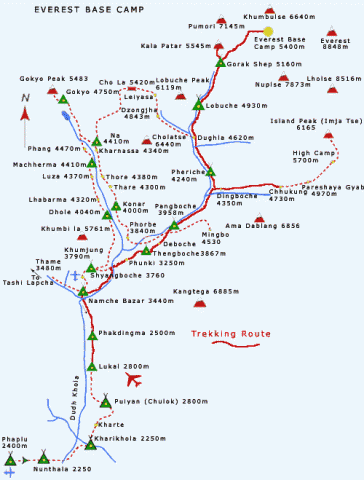
The first Sherpa team arrived at the Chinese Base Camp (CBC) on Tibet side for #Everest2018. Meanwhile more teams are arriving at Everest Base Camp (EBC) on the Nepal side. Everything seems to be on schedule thus far for the season. The Big Picture This past week on Everest has been busy with no surprises, just like it should be in early April. The weather is bit cloudy with rain down low and snow up high. In fact there are reports of heavy snowfall at EBC – but again this is fairly normal for early May. The Himalayan Times reported that the Ministry of Tourism has already issued climbing permits to 30 expedition teams for different mountains and over 140 climbers representing 15 teams for Mt Everest. I fully expect over 400 summits, foreign and local, from the Nepal side and 200 from the Tibet side this spring season. The first teams arrived at Everest Base Camp (EBC) on the Nepal side and the Icefall Doctors have the route put in all the way to Camp 1. Overall, it does not get better than this. The daily high temperature is in the 20’sF, at night it drops to single digits Fahrenheit. The winds pick up in the afternoon to 20 mph. Some posts are commenting that EBC is a bit cold. This is normal for early April but will warm up as the season moves towards summer. Trek Underway Many are still on their way to the base camps but a few are already posting updates. On a disappointing note, Ben Jones, leader for Alpine Ascents, posted a reward for his lost or stolen computer: $500 USD reward for my stolen MacBook Pro in the Khumbu either at Khumjung or Deboche. Bring or send to Alpine Ascents Basecamp and I will pay you no questions asked. The Jagged Globe team is making good progress: All the members of the climbing team and the trek team are now in Lobuje (4,910m). Two of the trekkers made the hike from Dingboche in five and a half hours with a Sherpa guide. The other team of 8 with two Sherpas made the 13.9km hike over the 5,535m Kongma La pass. The weather was perfect with clear skies and bright sunshine when the team set off at 07.00. As the morning progressed conditions became more overcast and the clouds increased. There was a bit of a view of surrounding peaks from the top of the pass but it started to snow heavily as the team descended. Navigating the crossing of the lower Khumbu glacier in a white out proved to be quite challenging, but the team reached the comfort of the Lodge at Lobuje at 14.30 after seven and a half hours of effort. Special mention goes to the three members of the trek team who set personal altitude records on the pass and coped admirably with the slippery snow on the descent Icefall Route Back Center The biggest news this week was that the Icefall doctors got the route in to Camp 1 in the lower Western Cwm. As I’ve noted this is good news as it allows the Sherpas to begin ferrying loads to establish camps. It appears the rope and anchor gear for fixing the rope above Camp 2 will be transported by helicopter this season thus eliminating many carries through the Icefall. In 2016, the Icefall route didn’t open until 11 April and in 2017, 2 April, so everything is right on schedule if not a bit early. According to an article in The Himalayan Times, the Icefall Doctors used 20 ladders to cross multiple crevasses. It’s unclear if there are 20 crevasses or they used 20 ladders. In any event this is about normal. Of more significance, Ang Dorjee Sherpa, who runs the Sagarmatha Pollution Control Committee (SPCC) said, “The newly opened route is the safest one compared to the past seasons.” He said the 2018 route follows the central traditional route with more blue ice but less hanging glacier. They also replaced the old Korean ropes with new Black Diamond static ropes. Again, it is normal to put new ropes in each year but good news that they improved the quality by using BD. He went on to claim “This route is the safest ever.” I will be interested in hearing from the long time expedition leaders as to their opinion of this year’s route. The Doctors have been criticized in the past for taking the easiest route thus putting it closer to the West Shoulder of Everest. This location is directly underneath the hanging serac that releases often. It was this serac that released in 2014 killing 16 Sherpas. They moved it more to the climbers right to minimize this objective danger as you can see in this diagram of the 2017 route. But to be clear, the work of the Icefall Doctors is difficult and dangerous and everyone appreciates their work. Teams arrive on Tibet side 7 Summits Club posted a nice video of a barren base camp on the Tibet side. Their Sherpas were the first to arrive and stake out their site. Note how different that side is from Nepal where EBC is on the Khumbu Glacier. Young Climbers As usual there are climbers hoping to set age records. You have to be 16 or older to climb from the Nepal side and between 18 and 70 on the Chinese side. This year, Indian Shivangi Pathak at age 16 is the youngest on the Nepal side. She is quoted saying “I am here to fulfill my childhood dream.” She is with Seven Summits Treks. On the Tibet side, Transcend Adventures has specialized in taking teenagers to the summit. This year they have 36 members supported by 55 Sherpas. They took the youngest female to the summit, Indian Malavath Poorna, 13 years 11 months on May 25, 2014 from the north side. The youngest person ever to summit was American Jordan Romero, age 13 years 11 months, on May 23, 2010 from the North side.
Everest 2018: Route to Camp 1 in Early
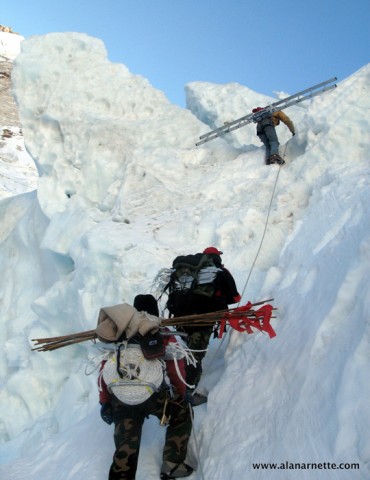
The fixed ropes are a pacing factor for all Everest expeditions so the progress is watched closely. With the Icefall Doctors doing the hard work, team after team are making the journey either on foot in Nepal or by Toyota 4Runner in Tibet to their respective base camps. It is extremely early in the season, but thus far no significant problems are being reported either with flights into Lukla or crossing the border into China from Nepal. However, the Kathmandu and lower Khumbu region seems to be experiencing unusually heavy rainfall. Can you Hear me now? There will be joy once they arrive at Everest Base Camp (EBC) on the Nepal side because it appears EverestLink is up and running. This means everyone will have access to wifi at a reasonable price of US$50 for 500 MB. I have not heard what the current price is but considering where you are, having instant access to high speed internet is pretty amazing. By the way, the signal does not go above base camp so satellite phones are still the most reliable way of communicating back home while up high. Route Fixing The Icefall Doctors have the route open to Camp 1 today. This is excellent in that it will allow teams to start early on their acclimatization rotations, and to get the camps established. This should help with any potential crowds as it will spread out the activity. There are 20 crevasse crossings using ladder in the Icefall and follows a more central route. There is a change in who is fixing the ropes above Camp 2 this year. Madison Mountaineering noted on their blog that they “secured an exclusive contract to fix the ropes from Camp 2 to the summit thus … By controlling the rope fixing we can control our climbing schedule better than before.” Previously the ropes were fixed by Sherpas selected from many teams and was consider an honor. For Sange I really like this post from David Snow. David was instrumental in helping young Dawa Sange Sherpa after he suffered extreme frostbite near the summit of Everest last year. Sange was guiding a Pakistani member, Col Abdul Jabbar Bhatti on the Nepal side of Everest on 21st May 2017. Bhatti refused to turn back claiming he had spent too much money turn back even thought it was after 4:00 pm. The member went home happy, and welcome as a hero, and Sange, through the amazing generosity of many, eventually found his way to Vail, Colorado where some of the best doctors in the world had to amputate all of his fingers due to the damage. I recently saw Sange and he was in amazing spirits but going through a very difficult physical recovery. You can read more on this post I did last year on Sange. David is returning to Everest this year and had this to say on his blog: In 1953 Bourdillon and Evans (left) came within 300’ of being the first to summit Mt. Everest. 3 days later their climbing partners Edmund Hillary and Tenzing Norgay finished the job. Last year a few of our guides Pasang and Tashi (right) got us 300’ from the top before the mountain had other ideas. In a few weeks we’re heading back to see if we can finish what we started. I have a few items to collect at the South Summit for Sange Sherpa and a few things I still need to place at the top. We’ve got another great expedition team as well as 19 friends to make the trek to base camp with us. Dhaulagiri Another peak I’m watching closely this spring is the world’s seventh tallest, Dhaulagiri. Not only is one of my climbing partners here in Colorado, Ryan Kushner, there but also the inspiring 79 year-old Spanish climber Carlos Soria Fontan. He has the age record for several 8000ers and only two left: Dhaulagiri and Shishapangma. Climb On! Alan Memories are Everything
Everest 2018: Climbers to Watch
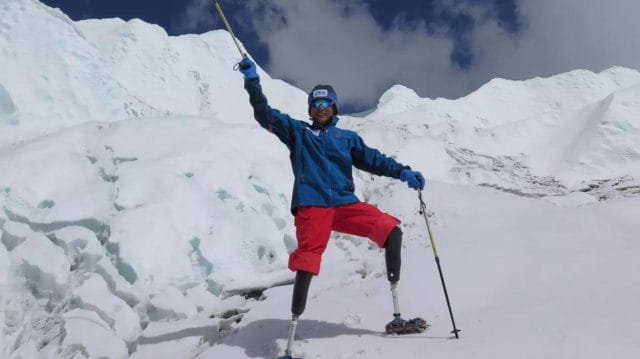
While every climber is special to their friends and family, a few stand out each year try to do something special. Teams are all over Nepal today, with many in the Khumbu, others still in Kathmandu. The flights to Lukla are full and thus far going smoothly. Every year, Everest attracts highly driven individuals seeking to summit for their own personal reason. I try to follow the most unique ones so let me introduce a few in this post. Horia Colibășanu – New Route? While there are about 17 named routes on Everest, there are still many routes that have not been attempted. Horia Colibășanu wants to put a new route up this spring season. This Romanian climber has a solid CV being the first Romanian to reach the summits of K2, Manaslu, Dhaulagiri and Annapurna. He summited Everest last year with out supplemental oxygen. He will be joined on Everest this season by Slovak mountaineer Peter Hámor who has summited all 14 8000ers. You can follow their climb on Horia’s blog and Facebook. There are no details on his plans but he is currently in Nepal and planning on acclimatizing in the Khumbu. I will keep updating his story. Kami Rita Sherpa – 22nd Summit? Kami Rita Sherpa, 48 from Thame, is aiming to summit Everest on the 29th of May, the 65th anniversary of the first summit by Edmund Hillary and Tenzing Norgay Sherpa. He will climb from the Nepal side. I know Kami Rita well as were were on K2 together in 2014 and summited within minutes of each other. This is a different Kami (Kami Tshering (Ang Chhiring) Sherpa – Pangboche) than I summited Everest with but he was also on K2 with us. Anyway, Kami Rita is well known throughout the climbing community as one of the strongest, steadiest and nicest persons you would ever meet. In addition to his 21 summits of Everest, he has 8 Cho Oyu summits, 1 Lhotse, 1 Manaslu and 1 K2 for a total of 32 summits of 8000 meter peaks. If he summits this year, and it is a 99.999% probability, he will break the record currently held by retried Sherpa guides Apa Sherpa from Thame and Phurba Tashi from Khumjung each with 21 summits. Kami Rita had worked for Alpine Ascents for many years but shifted to 7 Summits Treks for this year and possibly a couple more. He says he wants to reach 25 Everest summits before retiring himself. Lhakpa Sherpa – Female Record Owning the female summit record is not enough for Lhakpa Sherpa who lives in West Hartford CN, US, she wants to destroy it! Lhakpa is going for her ninth time with a summit this year. She began her dream of Everest as a 15 year-old porter helping others make the top, but soon she realized she had the natural ability to climb at altitude. She says she doesn’t train because she works all day washing dishes at Whole Food to support her two daughters according to her hometown newspaper. There have been 539 female ascents of Everest by 483 different women. Only 7 have summited without Os. 36 women have multiple summits with Lhakpa at the top of the list with eight followed by Melissa Arnot at six, Anshu Jamsenpa at five, Lydia Bradey at four and several others with three or two summits. Chinese Xia Boyu – Double Amputee This 70 year-old has a dream and not much will stop him – even politics. The Nepal Ministry tried to ban double amputees but their Supreme Court overruled the mandate thus supporting those with disabilities. The case was brought by Hari Budha Magar who lost both his legs above the knee to a bomb blast in Afghanistan in 2010 while serving in the British Gurkha Regiment. The politics delayed his attempt this year so he will try in 2019. However Xia Boyu is going ahead with his plans. This will be the his fifth attempt on Everest. His story is one of determination. On his 1975 attempt bad weather stopped him just above the South Summit. He and his teammates spent three nights at 8,600 meters in sub zero temperatures. Xia left his tent to help a teammate and lost both legs to frostbite according to this story on ExplorersWeb in 2007. His story continues when he developed lymph node cancer but still gave Everest another attempt in 2014 and 2015 but almost no one summited those years due to the Sherpa strike and earthquake. His fourth attempting 2016 again ended close to the summit but weather was the culprit again. Don Bowie – Speed Record After Kilian Jornet’s double summit at a very fast time, Don Bowie wants to give it a go. He posts on his blog, that he will attempt the summit from the Chinese Base Camp on the Tibet side for a no-oxygen speed record for climbing Everest. He went on to say that he feels confident based on his current fitness level and past performance at high altitude. While speed records are dubious, especially when starting and ending at different points, he is targeting Jornet’s 26 hour time from basecamp to summit time. In addition, he has targeted the most commonly accepted Everest speed climb record set by Hans Kammerlander in 1996 of 16:45 from Advanced Base Camp to the summit. Note: I have not been able to confirm if he found sponsors for this climb so it may not happen. Update: It seems he is not on Everest but will climb Kanchenjunga solo with no Os instead. Best of luck to all. Climb On! Alan memories are Everything
Everest 2018: Interview with Kuntal Joisher – Integrity in Motion
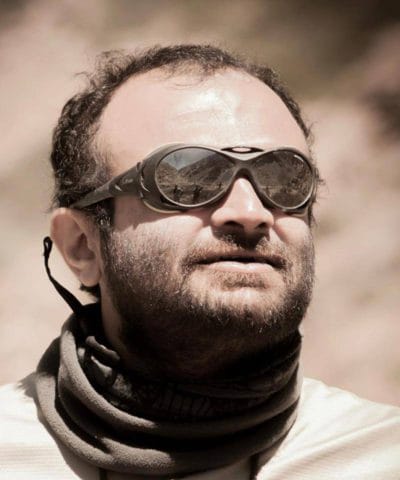
This interview with Kuntal Joisher is one of an ongoing series I do each season with Everest climbers. Not the famous, sponsored ones who get plenty of publicity but the regular people, who often have full time jobs, full time families and climb for the love of the climb. I welcome suggestions for anyone climbing in 2018 I should interview. My first interaction with Kuntal was in 2010 with an email that started “What attracted me to your website is a very important term in both our lives “Dementia”. Your mother passed away because of Alzheimers (most common form of Dementia), and my dad was diagnosed of Lewy body dementia back in 2002 at a very young age of 52 years. I can very well empathize with your situation about your mom. My dad is currently in advanced stages of his dementia, and one of my prime goals of life is to make sure he gets the best possible quality of however much life remains of him.” And with that we have been friends for eight years finally meeting at Everest Base Camp in 2016. I’ve come to admire this gentle man as a person of courage, conviction and integrity. He was thwarted, like so many, from his dream to summit Everest in both 2014 and 2015 but achieved his dream at 9:20 am May 19, 2016. The stereotype of Everest climbers is that of a selfish, rich person who hires many Sherpas to drag them to the summit. In my experience, that is a tiny percentage and not the majority. Kuntal is a role model for many Everest summiters, a person who has a long love of mountains that grew into mountaineering and one day took personal and financial risks to pursue his dream. He grew up in India, moved to Los Angels and then back to back to Mumbai, India in late 2006 to become the primary caregiver for his Dad. He has a world view that is reflected in his passionate speaking and writing, plus his photography. Kuntal has summited two 8000ers, Everest and Manaslu and is now going to attempt Lhotse in the Spring of 2018. Other peaks on his CV include Chulu far east, Island peak, Chamser kangri, Mentok Kangri , Mt Nakorche – first ascent – June 2013 , Mt Basisi – first ascent – June 2012 and Stok Kangri – July 2011. Kuntal received global recognition as being the first “strict” vegan to summit Everest. While he attracted many admirers, he also brought on the critics. That same year Maria (Marissa) Strydom’s died on Everest. She had a mission to ‘prove vegans can do anything” and her death created a tremendous amount of headlines around diet for climbers and in many cases lead to shameful ridicule of her beliefs and practices. As I processed that experience with Kuntal and that others had already claimed to have summit Everest as a vegan, he told me: “I don’t claim [to be the first to summit Everest]. Others claim on my behalf inspite of explicitly telling them that I may not be the first. And Dr. Atanos writes on his personal website – I am a Vegan who eats Honey. It’s like saying I am a Vegetarian who eats Fish. If you are a Vegan you don’t eat honey. Period. And if you eat honey then you are not a Vegan and should stop claiming to be one. Truly speaking no Vegan has summited Everest yet. Because as long as we use insulation jackets made of Down we are not Vegan. As simple as that. I have so many times told so many people I am not the first Vegan but no one listens. So I have stopped caring. If people want to write they can The more the word Vegan comes out and gets attached to me the more good it does to the overall cause. You can see my full interview with him at this link. With that, lets get deeper into Kuntal Joisher. Q: Lets start with the climb and motive behind this climb. Why did you choose Lhotse for your next 8000er? I’ll be very frank. Lhotse is not my first choice. Makalu was. Lhotse was my second choice. However, a couple of dear friends – Sylvain and Caroline, reputed alpinists from Quebec, and also with whom I share my first 8000 summit of Manaslu, signed up to climb Lhotse. That’s when I decided that I’ll also climb Lhotse since I wanted to climb with both of them again. And of course, I have always wanted to see how Everest looks from the top of Lhotse. And I have always wanted to climb through the Lhotse couloir. So I’ll be back again at Everest base camp in few days and I’m looking forward to crossing Khumbu ice-fall, walking through Western Cwm, finally climbing Lhotse face and then diverging to climb to the top of Lhotse. I’m very much looking forward to the challenge. Q: The final few hundred meters on Lhotse is notorious for dangerous rockfall. Are you doing anything special to stay safe? I don’t see Lhotse as any different from any other 8000er or for that matter any high mountain or for that matter any mountain – even one that can be climbed in a day. Over the last 9 years of my venturing into the mountains I have realized to never underestimate any mountain. Respect the mountain, take the right calls, and stay safe to climb another day. During my climbing career I have turned around quite a few times on my expeditions when I have deemed the conditions unsafe. Sure I lose money, time and all the effort goes in vain, but I’m alive, doing well, and have never had a case of even a frostnip on my expeditions. I think having the correct attitude on the mountain is very important. Now specifically to answer your question, in past few months my training has been completely centered around hiking and climbing quite a bit on exposed rock in the Western ghat mountains. I did this specifically to prepare for the Lhotse couloir which has similar terrain. I have already climbed to Camp
Everest 2018: Blessings on the Trek
“A journey of a thousand miles begins with a single step”, so says the famous Chinese proverb. For some of our Everest climbers their journey started on the other side of the planet, others a few hundred miles, or even tens of miles down the Khumbu. For all that first step in the Khumbu or at base camp on the Tibet side defines a milestone in their journey. Teams are trekking north up the Khumbu following the Dudh Koshi River and it’s free flowing rapids that seduce trekkers and climbers alike to wonder where is the source of that single drop of water. Perhaps it was from a small stream, a large rainstorm but most likely from the drainage of Mt. Everest. A Time to Think With our frenetic lives, many people rarely have a chance to get lost in thought for hours at a time. For our climbers and trekkers, this is their opportunity. In spite of the towering, 20,000 foot peaks that outline the track, it is easy to focus on the dirt trail two steps ahead. Your eyes go into the 1,000 yard stare while focusing on any random pebble or yak “residue” on the trail. Soon you are lost in thought. Each person is different. Some think of family, others work. Then there are those who visualize the journey ahead. For some this time will come full circle when they are pushing up the Lhotse Face in a ground blizzard searching for reassurance that their teammates are nearby. The winds gust higher and she questions if she can do this. Back on the trail in the Khumbu, she stops in her tracks, takes a deep breath and looks around and says to no-one “No, I wasn’t there, but soon will be.” And the climber continues the trek to base camp. Conflicting Images I like this post from Eric Murphy with Alpine Ascents (AAI) couple of days ago on Facebook. The down jackets are in full bloom and the table is neatly set. Some of the members seem like its time for bed. But there are also expressions of excitement and anticipation – yes this is what it is all about!!!! Khumbu Memories Of all of my treks in the Khumbu, these are two of my favorite images. From 2002, a young girl and in 2016, a young boy doing his best Fonzie imitation. This is why a trek in the Khumbu will change your life. Blessings One of the most meaningful moments, at least for me, was always the stop at Lama Geshi’s home in Pangboche. The 87 year-old passed away on February 13, 2018. This gentle man literally touched thousand of climbers and trekkers over several decades as they visited his home to receive a blessing of safety, forgiveness, permission and compassion. Now that he is gone, IMG noted on their blog that Lama Nawang Paljur is now the new Lama at the Pangboche Monastery and is blessing climbers this season. I miss my friend. Climb On! Alan Memories are Everything
Everest 2018: Weekend Update April 1
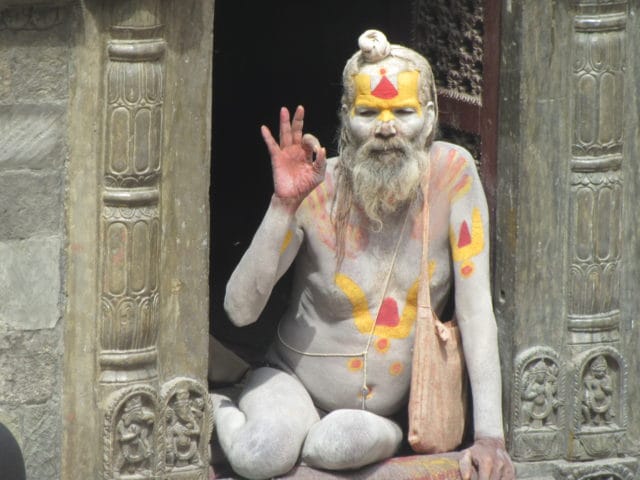
Well, it’s the 1st of April and the Everest machine is fully operational. Climbers from around the world are streaming into Kathmandu and others to Lhasa to begin their journey to the base camps on opposite sides of Mount Everest. For those just arriving, the excitement is palpable. For those left back home, the reality is just setting in. And for those who climbed last year, but are home today, their emotions are mixed. K-k-k-k-k-k Katmandu When the airplane door opens, you feel Nepal. You can taste the humidity, the thick air of Kathmandu. Deep down you know that your first step onto the tarmac will not be the last time you make this journey. Retrieving your bags reminds you that you have gone back in time by 50 years, perhaps to a small airport in rural Australia or Oban, Scotland. With bags on the wobbly trolley, you make your way past security noting the X-ray machine was unplugged. Your trust in the system is about to get the first test as you leave the airport and scan the line of drivers holding up signs. Then you see it, your name. Your tense and tried shoulders drop half an inch. This scene will be repeated about 500 times just for Everest climbers this season, tens times that if you include trekkers. The Everest season is not just about climbing, it’s also about the lifeblood of a country. Between the trekking and climbing industry, it’s estimated to bring in tens of millions of dollars to one of the world’s poorest economies. The average income in Nepal hovers around USD$600. Giving the guy who helped move your duffle one meter a $5 dollar tip reinforces why Nepal loves tourists. Meeting Strangers Meeting your team for the first time is always an exercise in human psychology. While you are certain that your experience and skills are more than sufficient to scale Everest, looking at some of your teammates causes you to question theirs! The time-honored process of forming cliques begins at dinner. You sort out who you want to walk beside and those you want to be separated from by a camp or two. Your guides make their first impression – type A personality or another “climber dude”. Regardless they will watch your every move for the next two months. Climbing has been a male-dominated sport but that is changing and for the better. As more women seek to join the summit team, the nature of the sport has evolved. No longer is it acceptable not to bathe or brush your teeth for weeks on end. The toilet humor jokes now take three minutes to begin instead of the usual three seconds over breakfast. The solitary individual who makes every rotation a competitive race no longer receives the “attaboy” from teammates. Women climbers are smarter, faster and safer than most of their male counterparts. You would be wise to partner up now. Bistārai, Bistārai After two days in the Khumbu or crossing the border at Zhangmu, you question the wisdom of spending $500 on your new fancy, highly-accurate altitude watch. Time moves like a sleeping dog in this part of the world. The strict training schedule and diet that held you hostage for the past year has now morphed into a life of eating as much as you can and sleeping as long as you can. Yes, you are now living the dream! On Kilimanjaro you learned Swahili for slow was “pole, pole” now you are learning it in Nepal, “Bistārai” or as Kami said to me often “No hurry, chicken curry” (never did figure that one out)! But language aside, there is a new pace to your world. You walk slow, eat slow, talk even slower. You actually pause on the trails to take in the view or at least get that great selfie to post on Facebook at the next teahouse. Yes, life’s great frustrations have shifted from slow drivers on the M4 to waiting for a yak train to pass by. Under Construction The base camps on both sides are scenes of challenging work. Before tents can be erected, platforms must be carved out of rock and ice on the Nepal side. The large tents used for cooking, storage and dining must be tied down to withstand high winds, especially on the north where it never relents making people yearn for a silent night’s sleep. Heavy trucks disturb the tranquility on the north while helicopters occupy the south. The days of a thousand porters marching in silent are gone forever. A few teams for the 2018 edition of Everest have already arrived but most are still driving or trekking. All are hoping EverestLInk will be up on the Nepal side and ChinaTelecom functional on the Tibet side. Access to WiFi has become standard for all teams on Everest. Relationships I began this article with a mention of how people may be feeling. I have often written about the “ones left behind.” The spouse, friends, family that gave you all that encouragement for so many years. They hoped that this day would come for you. Now that it has, they are coming to grips with what life will be like until June 1. The climber knows what they are doing each moment while those at home can only wonder what is happening on the other side of the world. For the climber, it’s show time. All the dreaming is now behind you. It’s time to stop training, wondering about gear, which guide to use and all the other thousand questions that have occupied your subconscious, and often your present state of mind, for way too long. If you are not excited today then your blood may already be cold. This is what you have been working hard to achieve, but it has also just begun. This is a marathon, not a sprint so relax and let every moment seep into your essence. And if you were on Everest last year, or