Welcome to Everest 2025. The season is still a few months away, and I’ll be posting several Everest 2025 big-picture updates before the season officially begins in early April:
2025 will be my 25th season of all things Everest: 19 times providing coverage, another four seasons of climbing on Everest, and two years attempting Lhotse.
I summited Everest on May 21, 2011, and have climbed on it three other times (all from Nepal) – 2002, 2003, and 2008, each time reaching just below the Balcony around 27,500′ (8400 meters) before health, weather or my judgment caused me to turn back.
I attempted Lhotse in 2015 and 2016. When not climbing, I cover the Everest season from my home in Colorado as I did in 2004, 2005, 2006, 2007, 2009, 2010, 2012, 2013, 2014, 2015, 2016,2017, 2018, 2019,2021,2022, 2023, 2024 and now the 2025 season. In 2020, when both sides of the mountain were closed due to COVID, I did a virtual series, Virtual Everest 2020 – Support the Climbing Sherpas, to raise money for the out-of-work Sherpa community working with nine commercial guiding companies.
Ida Arnette
Why This Coverage?
I have one reason for this coverage: Alzheimer’s. I lost my mom, Ida, and four aunts to the disease, which has changed my life. Please read more at this link. I hope you find value in my coverage and consider donating to select non-profits or any organization you prefer. I receive no financial benefit from your donations. Click the button on the right sidebar to donate.
The Himalayan Database
For those who closely follow Everest, the official release of the summit numbers is always a milestone. The Himalayan Database (HDB) updated the latest summit statistics in December 2024. I’ve dug into the stats and found some interesting trends and trivia. The HDB, a free download from their site, contains the climbing records for almost all Nepal and Tibetan Himalayan peaks from 1905 to today.
However, as Richard Salisbury and Billi Bierling told me, they changed their model because “the ever-increasing number of people attempting the commercial normal routes on the eight 8,000m peaks in Nepal; it is no longer possible for the team to interview every single climber or expedition leader, so they will concentrate on new and interesting routes on the 8,000ers and other commercial peaks, as well as new and technically challenging mountains that are climbed in Alpine style in the Nepal Himalaya.” They will now use climbing stats provided by the Nepal government. However, they still request that teams and climbers register for their climbs using this link.
Before we get into this, here are a few words on terminology. The HDB uses the term ‘hired’ to refer to anyone paid to support an expedition. So, ‘hired’ includes Sherpas, Tibetans, porters, and guides. In addition, several ethnicities support the Everest ecosystem, including Tamang, Magars, Rai, and others. On the north side, there are Chinese and Tibetan workers. Some articles refer to these as mountain workers or high-altitude workers.The term “member” usually refers to someone paying a guide to help them with their climb. I use the words “members,” “foreigners,” and “Westerners” interchangeably with members, acknowledging that climbers from South Korea, for example, do not consider themselves “Westerners.”
Preparing for Everest is More than Training
Everest, Denali, Aconcagua—what about K2? No matter your mountaineering goals, Summit Coach is here. We help you prepare to select the best guides and gear while also supporting your mental, physical, and emotional toughness. Alan Arnette has assisted hundreds of climbers since our founding in 2016. Please visit the Summit Coach websitefor information on prices and offerings.
For the 2025 spring Everest season, I anticipate 700 to 800 summits from both sides this spring, comprising at least 150 on the Tibet total (members plus hired) and well over 650 on the Nepal side. Even with these numbers, the totals will still lag the pre-pandemic record set in 2019 of 877 total summits, comprising 661 from Nepal and 216 from Tibet. Last year, 2024, 787 summits were from Nepal, and 74 were from Tibet. Looking at the overall numbers, we see that 7,269 climbers have summited Everest for 12,884 summits, and 335 people have died attempting Everest on all routes. Nepal remains the more popular and deadly side. Sherpas now dominate the majority of summits.
Summits and Deaths from 1922 to 2024
NEPAL
TIBET
TOTAL
Members
4,246
2,039
5,899
49%
Hired
4,910
1,689
6,097
51%
TOTAL Summits
9,156
3,728
12,884
69%
31%
Member Deaths
120
86
205
61%
Hired Deaths
105
24
130
39%
TOTAL Deaths
225
110
335
2.7%
64%
36%
Death Rate
1.14
1.08
1.12
Note that two events on the Nepal side represented 21% of the total hired deaths. In 2014, 17 people died when a serac let loose onto the Khumbu Icefall, and ten more died in 2015 when an earthquake created an avalanche that hit Everest Base Camp. A record 18 people died on the Nepal side in 2023.
2024 Review
Everest 2024 might be remembered for summits, politics, deaths, ignored rules, near misses and disturbing allegations of sexual misconduct. Putting all this in a headline is challenging, but I believe the Everest guiding industry is at a Rubicon – a point of no return. Not to be lost in this mix is the joy and satisfaction felt by hundreds of summiteers. They worked and trained diligently to celebrate standing on the top of the world for only a few minutes. It’s funny how you can work so long for a goal, and the moment is over in a blink, but the memory lasts a lifetime—well done to all who summited, to those who showed up. Once again, the Sherpas proved they dominated the mountain with impressive altitude performance.
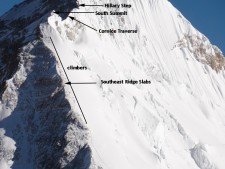
The Himalayan Database shows that between 1953 and 2024, 6,097 Sherpas have summited Everest compared to 5,899 members, and that gap is growing each year. However, more foreigners have died than Sherpas, 225 compared to 110. We may have heard the last chirps from Everest’s “canary in the coal mine.” Between the difficulty of getting the fixed ropes through the Icefall and the collapse of a cornice at the Hillary Step, climbing the reliable Southeast Ridge route could be at risk. The cause is most probably a warming environment. As for summits, the Himalayan Database reported in December 2024, based on numbers reported by the Nepal government:
Summits and Deaths for 2024
NEPAL
TIBET
TOTAL
Members
319
51
370
43%
Hired
468
23
491
57%
TOTAL Summits
787
74
861
% of Total
91%
9%
Summit Rate
68.25
67.27
68.17
Member Deaths
6
0
6
61%
Hired Deaths
2
0
2
39%
TOTAL Deaths
8
0
8
% of Total
100%
0%
Death Rate
0.69
0
0.63
Price matters when it comes to safety. In 2023 and 2024, 23 of the 26 deaths were climbed, with operators charging under the median price.Continue reading about Everest 2024
2025 Preview
I suspect 2025 will be another busy year. First, there is the insatiable lure of Everest, and, as is the standard since 2013, droves of inexperienced climbers drawn by “no-experienced required” low-cost operators. However, 2025 will be different; the north side is open to foreigners. Nepal will now implement the Everest (and presumably other 8000ers) climbing permit fee from $11,000 to $15,000 in September 2025, not impacting the Spring season. What the consequences will be is unknown.For the 2025 spring Everest season, I anticipate 700 to 800 summits from both sides, including at least 150 on the Tibet side (members plus hired) and well over 650 on the Nepal side. Even with these numbers, the totals will still lag the pre-pandemic record set in 2019, which was 877 summits, 661 from Nepal and 216 from Tibet. I expect 2025 to be a strong year on Everest, with more summits, deaths and controversy.
Everest has an immutable attraction that is oddly perverse. When there is a record number of deaths, the following season has more climbers than the previous deadly one. For example:
2006: 11 deaths, 494 summits
2007: 7 deaths, 634 summits +25%
2012: 10 deaths, 581 summits
2013: 8 deaths, 684 summits +17%
2014*: 16 deaths, 134 summits
2016: 5 deaths, 679 summits
2023: 18 deaths, 668 summits
2024: 8 Deaths, 861 summits +25%
* The 2014 season ended early when 16 Sherpas died in Icefall. 2015 closed because of the earthquake.
Since 1953, 7,269 different people have summited Everest on all routes 12,884 times. Those climbers who have summited multiple times include 1,670 members and 2,003 Sherpa, for 4,620 total summits. There have been 962 summits by women members. The Nepal side is the most popular and has the highest death total and death rate, with 9,156 summits and 225 deaths or 2.7%, a rate of 1.13. The Tibet side has seen 3,728 summits with 110 deaths or 3.0%, a rate of 1.08.
For those not using supplemental oxygen from Nepal, 116 died, or 51% of the total deaths on that side. On the Tibet side, for those not using supplemental oxygen, 41 died, or 37% of the total deaths on that side. Tibet-side climbers tend to be more experienced, thus accounting for fewer deaths. For both sides, 157 climbers died while not using supplemental oxygen out of 335 total fatalities or 47%. Note that the death rates are for all hired support and members, including those at base camp, not just those who summited. The last time Everest saw no summits on either side was in 1974.
source: Himalayan Database
Tibet or Nepal Side?
Before 2008, Tibet had been gaining popularity. In the 2000 climbing season, Nepal had 62% of the total climbing traffic compared to Tibet’s 38%. However, by 2007, the gap had closed, with Nepal at 59% and Tibet at 41%. Then came 2008, when the Chinese effectively closed Everest to take the Olympic torch to the summit. This event caused many operators not to risk their money with the Chinese and moved to the Nepal side, some for good. China’s closure of Everest to foreigners from 2020 through 2023, citing COVID, exacerbated this trend.
Russell Brice, a mainstay on the north from 1994 to 2007, putting 219 people on the summit, including 53 in 2007, switched to the south after the 2008 closure on the north, contributing to the momentum stall on that side. A few years ago, Brice sold his company, Himalayan Experience. Tibet’s comeback has been uneven, complicated by China’s ever-changing tourism policies and the pandemic. It may never reach the pre-2008 days because China caps members at 300 per season while Nepal continues to have no limit. In 2019, the last full year on the Tibet side, Nepal regained its domination with 75% of the traffic.
source: Himalayan Database
Natural Disasters and Rising Fees
The 2014 avalanche, the ensuing Sherpa strike, and the 2015 earthquake sent some people back to the Chinese side; however, these events had little impact on climbing from either side and were viewed as natural disasters not unique to either side.One wildcard that may impact the growth on the Chinese side is the permit fee. An Everest climbing permit from the Chinese (Northside) is now between $15,800 and $18,000 per person for a team permit of 4 or more. Please see my “How Much Does it Cost to Climb Everest: 2025 Edition” for a detailed breakdown since Tibet bundles many services in that fee. The days of climbing Everest for a few thousand dollars are over.
Deaths Ticking Back Up
335 people, 217 members, and 110 hired (Sherpas) died on Everest from 1921 to 2024. Since the first attempt in 1922, an average of 5 people have died each year. From 2010 to 2024, deaths rose dramatically to an average of 8 annually. The 31 total Sherpa deaths in 2014 from the Serac release onto the Icefall and the 2015 earthquake drove up the average death rate, as did the record 18 deaths in 2023. All of these deaths were on the Nepal side of the mountain.Digging deeper into each period, the death rate from 1921 to 1999 was 1.80, with 170 people dying, 100 members, and 70 hired. More members died than hired due to pioneering new routes, and the Sherpas were primarily used for load carrying. When commercialization grew in the early 2000s, the death rate drastically declined from 1.80 to 0.80. There were fewer new routes, and most of the traffic took place on the Southeast or Northeast Ridges led by Western Guide companies like Adventure Consultants, Alpine Ascents International, Jagged Globe, Himex or International Mountain Guides, and today by relatively newer Western companies like Climbing the Seven Summits, Furtenbach Adventures and Madison Mountaineering plus Nepali companies like Asian Trekking, 8K Expeditions and Seven Summits Treks. From 2000 to 2024, 165 people died, a death rate of 0.77, but more members, 106, still died than Sherpas, 59. source: Himalayan Database
The reduction in overall deaths is primarily because of significantly higher Sherpa support ratios, improved supplemental oxygen at higher flow rates (up to 8 lpm), improved gear, weather forecasting, and more people climbing with commercial operations. This good news of fewer deaths (1921-1999:170 compared to 2000-2024:165) came as the number of people climbing Everest took off. The number of people above Nepal’s Base Camp almost tripled in the past 25 years -14,641 (6,375 members with 8,266 support) compared to the previous 80 years. From 1921 to 1999 – 5,585 (2,796 members with 2,789 support) people went above BC. However, death statistics show that on both sides, on all routes, descending from the summit bid is significantly more deadly for members, with 108 deaths descending, compared to 29 ascending on both sides.
Of the 8,000-meter peaks, Everest has the highest absolute number of deaths (member and hired) at 335 but ranks near the bottom with a death rate of 1.11. Annapurna is the most deadly 8,000er, with one death for about every fifteen summits (73:514) or a 3.30 death rate. Cho Oyu is the safest, with 4,158 summits and 52 deaths, or a death rate of 0.54, with Lhotse next at 0.61. K2’s death rate has fallen dramatically from the historic 1:4 to around 1:8, primarily due to more commercial expeditions with large Sherpa support ratios.
It’s still critical to carefully research and select your guide as I cover in Everest 2024: Season Summary – Everest at a Rubicon. Price matters when it comes to safety. In 2023 and 2024, 23 of the 26 deaths were climbers, with operators charging under the median price.While the Nepal side’s safety reputation eroded after the tragic 2014, 2015, and 2023 deaths, the Tibet side has also had multiple deaths. In 2004 and 2006, six and eight people died, respectively. There have been a few years when there have been no deaths in Everest, for example, in Nepal in 2010 and Tibet in 2016. 1981 was the last time Everest saw no deaths on either side.Note that the HDB calculates the death and summit rate by counting the number of people who died above base camp, not just those who summited.
Why Do You Need a Coach and Why Alan?
Navigating the internet for the best company to climb with on the highest peaks can be overwhelming. Alan’s experience can help you save money and boost your chances of achieving your goals.
Alan’s unique industry experiences include climbs, summits, sponsorships, and organization. He ran track in high school and set state records, but his fitness level didn’t translate to climbing at high altitudes (above 10,000 feet) when he began at age 38.
He has affordable, proven physical training and mental toughness programs. Many Summit Coach clients have limited or no experience, while others have successfully climbed dozens of summits and seek help for their next big challenge. Regardless of your experience level, Summit Coach offers an honest program without the false promises of a “summit with no experience.” Please visit the Summit Coach websitefor information on prices and offerings.
Standard-98% vs. Non-Standard Routes-2%
An interesting bit of trivia is that through December 2024, of the 12,884 summits, only 187 (141 members and 46 hired) took a “non-standard” route, not the Southeast Ridge or Northeast Ridge, to the summit. There were 70 (44 members and 26 hired) deaths on these climbs–21% of the total deaths, which partly explains why the standard routes are most popular with commercial operators–lower risks. The countries with the most summits on the non-standard routes are Nepal (67), Japan (26), the USA (27), S. Korea (23), the USSR (23), and Russia (16.)As this chart shows, climbing the standard routes accounts for 79% of the deaths, with the Southeast Ridge dominating all deaths at 175 or 52%. This number is heavily driven by the 2023 record of eighteen deaths and the 2014 ice serac release off the West Shoulder of Everest onto the Khumbu Icefall, taking 17 lives. Also, 14 people died at Basecamp in 2015 after a 7.8 magnitude earthquake caused an avalanche off the Pumori-Lintgren ridgeline. Whether these were one-time events or ongoing concerns has yet to be determined. Therefore, climbers must make decisions about the safer standard route. Here is the death summary through 2024:
Reason
Northeast Ridge
Southeast Ridge
Other Routes South
Other Routes North
total
Avalanche
9
41
13
14
77
Fall
18
34
18
8
78
AMS
12
31
0
5
48
Exposure/Frostbite
11
10
2
3
26
Illness (non-AMS)
5
18
1
1
26
Exhaustion
12
17
0
1
30
Icefall Collapse
0
17
2
0
19
Crevasse
0
10
0
0
10
Disappearance
4
6
0
3
13
other/unknown
3
2
1
1
7
Falling Rock/Ice
0
5
0
0
5
Total
74
191
34
36
335
Death Rate for those above BC
0.89
1.02
2.28
1.83
% of Total
21%
52%
13%
12%
The last team to complete a new route was a Korean team on the Southwest Face in 2009. In 2019, Cory Richards and Esteban “Topo” Mena made a valiant attempt to send a 6,551-foot direct line in a couloir, a narrow rock gully, on the Northeast face of Everest. The gully joins a high ridge, continues to a steep face, and on to the summit. The route began just above Advanced Base Camp at 21,325 feet on the Tibet side of Everest. Eventually, they turned back at around 7,600 meters due to “conditions we encountered coupled with our chosen tactics compounded by exertion.” after spending 40 hours on the wall with one open bivvy.
Oxygen and Summits and Deaths
It is rare to summit Everest without supplemental oxygen; only 230 people have ever done so, a scant 1.8% of the total summit since 1953. Digging deep into the data reveals that of the 335 deaths, 178 were not using O’s when they perished, but this is a bit misleading because, for many of the deaths, 104 were doing route preparation, primarily by Sherpas. Most would not have used Os because they were low on the mountain. A case in point was the 2014 ice serac release and the 2015 earthquake that killed 31 people, and they were below Camp 1 and not using oxygen.Looking at modern climbing on both sides of Everest from 2000 to 2024, summit chances for members, not Sherpas, with and without Os. Of the 6,689 members hoping to summit, 5,401 summited with Os or 80%. For members climbing without supplemental oxygen, 96 out of the 665 members summited, for a summit percentage of 15%. In other words, you have a five times greater chance to summit when using supplemental oxygen. As for members, not Sherpas, death rates with and without Os, looking at modern climbing on both sides of Everest from 2000 to 2024, for members hoping to summit with Os, of the 5,401 members, 73 died for a death percentage of 1.1%. Of the members climbing above BC without supplemental oxygen, 28 died, a death percentage of 5%. In other words, you have a five times higher chance of dying when not using supplemental oxygen. The bottom line is to use supplemental oxygen to increase your summit chances and return home alive.
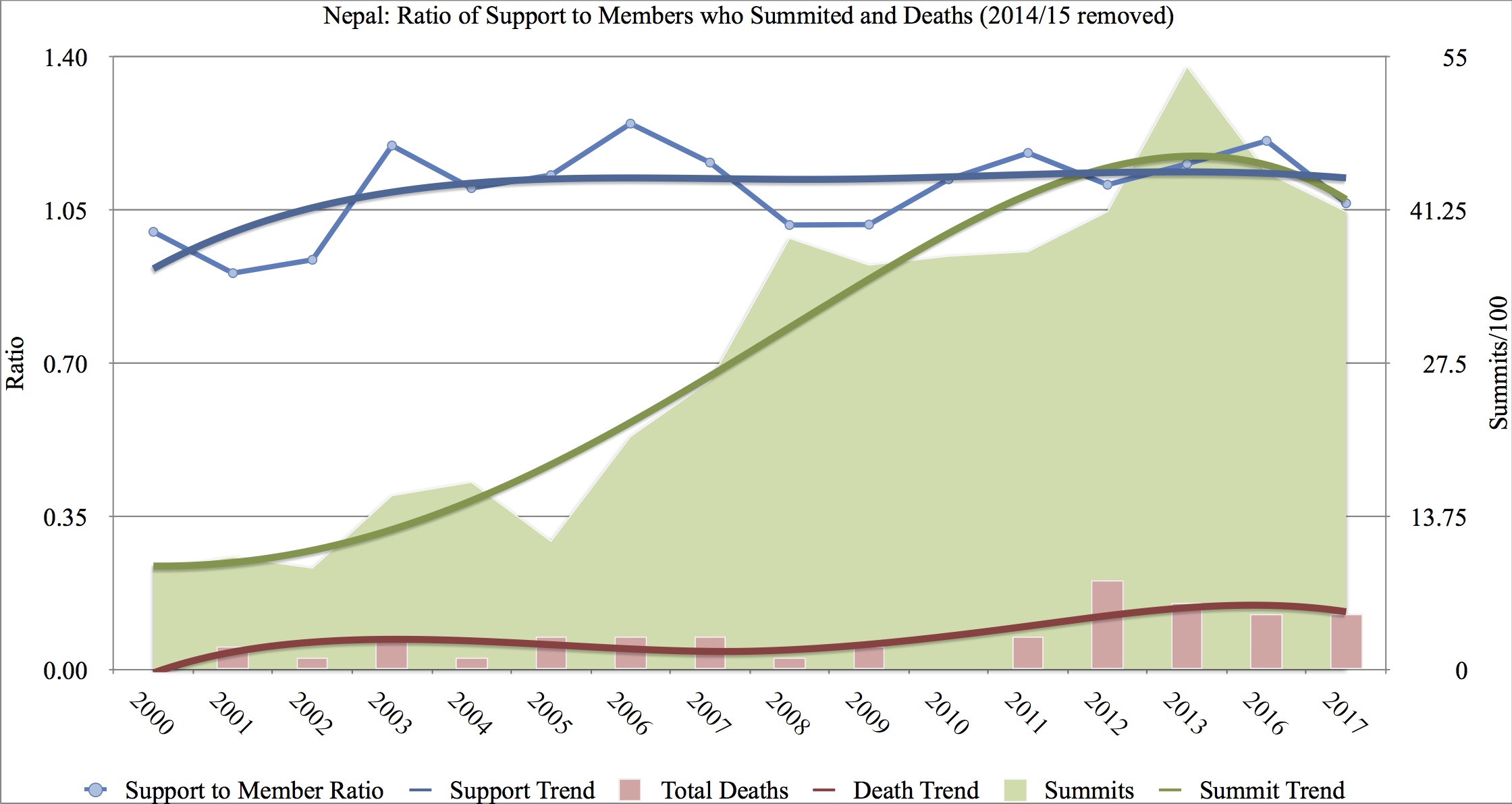
Sherpa Support and Summits
Over the last 15 years, Everest has seen explosive growth in Sherpa summiting. In the early days of Everest’s exploration, having one Sherpa supporting three or four professional climbers was typical, or 1:4, 25%. Then, in the 1990s and early 2000s, commercial operators increased support, often having a ratio of two or three Sherpas supporting five clients (members) 3:5, 60%. Today, two Sherpas for each member are common: 2:1, or 200%. More inexperienced members drive this extra support need, offloading more gear to Sherpas and a higher oxygen flow rate, thus requiring more bottles and Sherpas to carry them and high-end guides who market that there will always be a Sherpa climbing by your side.
When commercialization began on the south side in 1992, 22 Sherpas and 65 members summited, resulting in a ratio of 0.34 members per hired Sherpa. In 2010, 196 Sherpas with 175 members summited, giving a ratio of 1.12. The situation on the Tibet side is even more dramatic. In 2000, the ratio was 17:38 or 0.45 hired to members, compared to 106:110 or 1.04 in 2019 (the last full year on the Tibet side). In 2024, on the Nepal side, it was a whopping 1.5. In other words, 1.5 Sherpas reached the summit for every member. In 2022, it was a staggering 1:1.62, with 415 Sherpas summiting alongside 256 clients on the Nepal side. Today, more Sherpas and Tibetans have summited Everest than paying clients, 6,590 vs. 6,283. As this chart shows, the support ratio trend is increasing faster on the Nepal side.
source: Himalayan Database The 2008 dip in the chart for Tibet was when China closed the mountain for the Olympics, and there were no foreign climbs from 2019 – 2023.
Everest – An Insatiable Allure
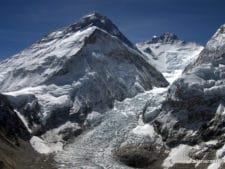
As the previous discussion shows, the number of summits has increased since 1992 when Adventure Consultants Rob Hall and Gary Ball guided four paying members to the summit, which began widespread commercialization. David Breashears guided Dick Bass in 1985 and got credit for starting the entire industry of commercializing Everest; others followed quickly, including Kari Kobler, Kolbler and Partner and Todd Burleson, Alpine Ascents International. Even with significant price increases, Everest still draws a crowd each year. Over the past ten years, companies with Western guides on the Nepal side have increased their average prices from $64,000 to $71,500 today, while Nepali guides have gone from $35,000 to $45,000 but are often heavily discounted by up to 25%. On the Tibet side, prices have exploded from $32,750 to $75,000, driven mainly by Western teams marketing “rapid/flash/speed” programs that require more support than the traditional schedule.Everest, Lhotse and Nuptse from Pumori Camp 1
Interest in mountaineering rose steadily after the 1996 disaster when 15 people died. The drop-off in summits in 2008 was when the Chinese closed the north side for the Beijing Olympics, effectively stalling momentum on that side. Two more years caused significant disruptions in climbing the peak when, in 2014, a Sherpa strike closed the Nepal side, and in 2015, the earthquake stopped all summits on both sides.
And, of course, COVID has disrupted climbing in 2020 through 2023 on the Tibet side and just in 2020 on Nepal, which refused to close the mountain and give up any revenue. But it is good to understand that the following year results in record summits after each of those ‘bad’ years. So it seems bad news only increases the allure of climbing Everest, like bugs to bright light.
Everest Trivia
In the trivia department, the Himalayan Database shows:
One true solo ascent Messner, 1980 North
35 traverses
22 ski/snowboard descents
13 Parapente (paragliding) descents
15 disputed ascents
14 unrecognized ascents
Fun Facts
I have a section on my main website called Everest for KiDs. It is based on my 2002 attempt at Everest, where I did not summit, and today, schools around the world use it to teach students about goal setting, geography, and Everest. Part of that section contains these fun facts: Geography
Everest is 29,031.69-feet or 8848.86-meters high
The summit is the border of Nepal to the south and China or Tibet to the north
It is over 60 million years old
Everest was formed by the movement of the Indian tectonic plate pushing up and against the Asian plate.
Everest grows by about a quarter of an inch (0.25″) every year
It consists of different types of shale, limestone and marble rock
The rocky summit is covered with deep snow all year long
Weather
The Jet Stream sits on top of Everest almost all year long
The wind can blow over 200 mph
The temperature can be -80F (-62C)
In mid-May each year, the jet stream moves north, calming the winds and warming temperatures enough for people to try to summit. This is called the ‘summit window’. A similar period occurs each fall in November.
It can also be very hot, with temperatures over 100F (38C)in the Western Cwm, an area climbers go through to reach the summit.
History
Like all mountains worldwide, the local indigenous people were the first to see it.
Everest is called Chomolungma (Jomolangma) by the Tibetan people. It means mother goddess of the universe.
The Nepal Government named Everest – Sagarmatha. It means goddess of the sky.
It was first identified for the Western world by a British survey team led by Sir George Everest in 1841.
Everest was first named Peak 15 and measured at 29,002 feet in 1856.
In 1865, it was named Mount Everest, after Sir George Everest.
In 1955, the height was adjusted to 29,028 feet.
China used 29,015 feet for decades
In 2020, using GPS technology and a joint measurement by Nepal and China, 29,031.69 feet (8,848.86 m) were recorded. Both countries use this now.
Summits – updated December 2024 Early Attempts and Summits
The first attempt was in 1921 by a British expedition from the north (Tibet) side.
The first summit was by Sir Edmund Hillary from New Zealand and Tenzing Norgay, a Sherpa from Nepal, on May 29, 1953. They climbed from the south side on a British expedition led by Colonel John Hunt.
The first north side summit was on May 25, 1960, by Nawang Gombu (Tibetan) and Chinese climbers Chu Yin-Hau and Wang Fu-zhou.
The youngest person to summit is American Jordan Romero, 13 years and 11 months, who was born on the north side on May 23, 2010.
The oldest person to summit is Japanese Miura Yiuchiro, age 80, on May 23, 2013
The first climbers to summit Everest without bottled oxygen were Italian Reinhold Messner and Peter Habler in 1978
Reinhold Messner is the only person who has summited Everest alone without supplemental oxygen. He did it in 1980 from the Tibet side via the Great Couloir.
Male Summits
The youngest male to summit is American Jordan Romero, 13 years and 10 months, who reached the summit from the north side on May 23, 2010.
The oldest male to summit is Japanese Miura Yiuchiro, age 80, on May 23, 2013
Kami Rita (Topke) Sherpa (Thami) holds the record for most summits (male or female) with 31, the most recent one in May 2024.
Pasang Dawa Sherpa of Pangboche has summited 27 times, the last of which was in May 2024.
Apa Sherpa (Thami Og) and Phurba Tashi Sherpa (Khumjung) are next, with 21 summits each. Both are now retired.
Briton Kenton Cool has the most non-Sherpa summits, with 17, the most recent in 2023.
Female Summits
The first woman to summit Everest is Junko Tabei of Japan in 1975
The oldest woman to summit is Japanese Tamae Watanabe, age 73, in 2012 from the north
The youngest woman to summit is Indian Malavath Poorna, 13 years 11 months, on May 25, 2014, from the north side
883 women have summited through December 2024
Nepali Lakpa Sherpani, 48, holds the women’s summit record with ten (3 South, 7 North)
Summit Statistics
There have been 12,884 summits of Everest through December 2024, on all routes by 7,269 different people.
6,285 members (clients) have summited, and 6,593 hired (Sherpas)
962 females have summited.
1,670 people have summited multiple times
Sherpas have the most summits at 6,623 by 2,003 different people
101 Sherpas have summited Everest ten or more times.
There are 1,166 Sherpas with multiple summits totaling 4,620 summits
The Nepal side is more popular, with 9,156 summits compared to 3,728 summits from the Tibet side
229 climbers summited without supplemental oxygen through December 2024, about 1.7%
35 climbers have traversed from one side to the other.
681 climbers have summited from both Nepal and Tibet
172 climbers have summited more than once in a single season, including 84 who summited within seven days of their first summit that season.
About 66% of all expeditions put at least one member on the summit
Member climbers from the USA have the most country member summits at 1,078, followed by China at 683, India at 605 and the UK at 560.
Death Statistics
335 people have died on Everest from 1922 to December 2024. This is about 2.7% of those who summited or a death rate of 1.11 of those who attempted to make the summit.
203 westerners and 129 Sherpas have died on Everest from 1922 to December 2024.
Member climbers aged 65-69 have the highest death rate at 2.94.
Westerners die at a higher rate, 1.36, compared to hired at 0.84.
Of the member deaths, 122 died attempting to summit without using supplemental oxygen.
14 women have died, with a death rate of 0.81 compared to 1.14 for male climbers.
Of the 327 deaths, 93 died on the descent from their summit bid or 2.8%
The Nepalese side has seen 9,156 summits with 225 deaths through December 2024 or 2.5%, a rate of 1.12. 130, or 27% of the deaths did not use Os.
The Tibet side has seen 3,728 summits with 98 deaths through December 2024 or 2.6%, a rate of 0.98. 38 died not using Os.
Climbers from the UK and Japan have the most all-time deaths at 17
Most bodies are still on the mountain, but China has removed many bodies from sight.
The top causes of death on both sides were avalanche (77), fall (75), altitude sickness (48) and exposure (26).
From 1922 to 1999, 170 people died on Everest, with 1,170 summits or 14.5%. But the deaths drastically declined from 2000 to 2023, with 10,826 summits and 157 deaths or 1.4%.
However, four years skewed the death rates: 17 in 2014, 14 in 2015, 11 in 2019 and a record 18 in 2023.
At least 11 of the 2023 deaths were preventable through better logistics, adequate oxygen and better on-mountain support.
The reduction in deaths is primarily due to higher levels of Sherpa support, supplemental oxygen at higher rates, better gear, weather forecasting and more people climbing with commercial operations.
Latest: Spring 2024
In 2024, there were 861 summits, including 74 from Tibet and 787 from Nepal,
All but 5 used supplemental oxygen.
77% of all attempts by members were successful.
Of the total, 73 females summited.
The Tibet side saw a 67% summit rate compared to 68% on the Nepal side.
There were 8 deaths of Everest climbers.
Climbing
There are 18 different climbing routes on Everest.
It usually takes 40 days to climb Mt. Everest for the body to adjust to the high altitude.
Some climbers use altitude tents to “pre-acclimatize” at home, thus reducing an Everest expedition to between two and three weeks, home to home.
There is 66% less oxygen in each breath on the summit of Everest than at sea level.
Thin nylon ropes attached to the mountainside are used to keep climbers from falling.
Climbers wear spikes on their boots called crampons
They also use ice axes to help stop a fall
Thick, puffy suits filled with goose feathers keep climbers warm
Most climbers eat a lot of rice and noodles for food
Almost all climbers use bottled oxygen because it is so high. It helps keep the climbers warm.
Climbers start using bottled oxygen at 26,000 feet, but it only makes a 3,000-foot difference in how they feel, so at 27,000 feet, they feel like they are at 24,000 feet.
You must be 16 or older to climb from Nepal and between 18 and 60 on the Chinese side.
The average expedition takes about 37 days.
Sherpas
Sherpa is the name of a people. They mostly live in eastern Nepal. They migrated from Tibet over the last several hundred years.
Sherpa is also used as a last name
Usually, their first name is the day of the week they were born.
Nyima – Sunday
Dawa – Monday
Mingma – Tuesday
Lhakpa – Wednesday
Phurba – Thursday
Pasang – Friday
Pemba – Saturday
Climbers hire Sherpas to guide them, carry tents, and cook food for the high camps.
Sherpas climb Everest as a job to support their families
Sherpas can get sick from altitude like anyone but are stronger at altitude than foreigners.
Sherpas feel it is disrespectful to stand literally on the tippy top since that is where Miyolangsangma, the Tibetan Goddess of Mountains, lives.
Trivia
Babu Chiri Sherpa spent the night at the summit in 1999
Kami Rita (Topke) Sherpa (Thami) holds the record for most summits (male or female) with 31, the most recent one in 2024
Over 33,000 feet of fixed rope is used each year to set the South Col route
You have to be at least 16 to climb Everest from the south side and 18 from the north
Climbers burn over 10,000 calories each climbing day, double that on the summit climb
Climbers will lose 10 to 20 lbs during the expedition
Climb On!
Alan
Memories are Everything
The Most Common Mistakes Climbers Make
The most common mistakes climbers make include underestimating the effects of altitude on their bodies and overestimating their physical abilities. Summit Coach can help you achieve a balanced approach to preparation and clarify the confusing advice often found online. Please visit the Summit Coach websitefor information on prices and offerings.
Always so factual and informative, thanks for all your research and passion.
Thank so much, Sparky.
Alan,I love your writing, and I always get happy when I “see” you
Cookie Consent
We use cookies to improve your experience on our site. By using our site, you consent to cookies.
This website uses cookies
Websites store cookies to enhance functionality and personalise your experience. You can manage your preferences, but blocking some cookies may impact site performance and services.
Essential cookies enable basic functions and are necessary for the proper function of the website.
Name
Description
Duration
Cookie Preferences
This cookie is used to store the user's cookie consent preferences.
30 days
These cookies are needed for adding comments on this website.
Name
Description
Duration
comment_author_url
Used to track the user across multiple sessions.
Session
comment_author_email
Used to track the user across multiple sessions.
Session
comment_author
Used to track the user across multiple sessions.
Session
Google Tag Manager simplifies the management of marketing tags on your website without code changes.
Name
Description
Duration
td
Registers statistical data on users' behaviour on the website. Used for internal analytics by the website operator.
session
cookiePreferences
Registers cookie preferences of a user
2 years
Statistics cookies collect information anonymously. This information helps us understand how visitors use our website.
Google Analytics is a powerful tool that tracks and analyzes website traffic for informed marketing decisions.
Used to monitor number of Google Analytics server requests when using Google Tag Manager
1 minute
_gid
ID used to identify users for 24 hours after last activity
24 hours
_gali
Used by Google Analytics to determine which links on a page are being clicked
30 seconds
_ga_
ID used to identify users
2 years
__utmv
Contains custom information set by the web developer via the _setCustomVar method in Google Analytics. This cookie is updated every time new data is sent to the Google Analytics server.
2 years after last activity
__utmx
Used to determine whether a user is included in an A / B or Multivariate test.
18 months
_ga
ID used to identify users
2 years
__utmc
Used only with old Urchin versions of Google Analytics and not with GA.js. Was used to distinguish between new sessions and visits at the end of a session.
End of session (browser)
__utmz
Contains information about the traffic source or campaign that directed user to the website. The cookie is set when the GA.js javascript is loaded and updated when data is sent to the Google Anaytics server
6 months after last activity
__utmb
Used to distinguish new sessions and visits. This cookie is set when the GA.js javascript library is loaded and there is no existing __utmb cookie. The cookie is updated every time data is sent to the Google Analytics server.
30 minutes after last activity
__utmt
Used to monitor number of Google Analytics server requests
10 minutes
__utma
ID used to identify users and sessions
2 years after last activity
_gac_
Contains information related to marketing campaigns of the user. These are shared with Google AdWords / Google Ads when the Google Ads and Google Analytics accounts are linked together.







Always so factual and informative, thanks for all your research and passion.
Thank so much, Sparky.
Alan,I love your writing, and I always get happy when I “see” you