Welcome to Everest 2025. The season is still a few months away, and I’ll be posting several Everest 2025 big-picture updates before the season officially begins in early April:
2025 will be my 25th season of all things Everest: 19 times providing coverage, another four seasons of climbing on Everest, and two years attempting Lhotse.
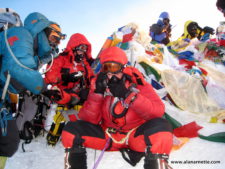
I summited Everest on May 21, 2011, and have climbed on it three other times (all from Nepal) – 2002, 2003, and 2008, each time reaching just below the Balcony around 27,500′ (8400 meters) before health, weather or my judgment caused me to turn back.
I have one reason for this coverage: Alzheimer’s. I lost my mom, Ida, and four aunts to the disease, which has changed my life. Please read more at this link. I hope you find value in my coverage and consider donating to select non-profits or any organization you prefer. I receive no financial benefit from your donations. Click the button on the right sidebar to donate.
Bottom Line
For 98% of all Everest climbers, the choice of routes is the Northeast (Tibet) and Southeast (Nepal) Ridges. For today’s commercial clients, all other routes are too dangerous, complicated, and not commercially guided. This post will examine the various routes and explore the most popular commercial ones. It may be exaggerated to say that all the routes on Everest have been climbed because the next generation of climbers continuously blazes new trails. However, climbing Everest appears well understood across all aspects of the hill. There are about twenty named routes, almost all of which have been tried at least once, with teams summiting. Many sections and parts of well-known routes still have not been climbed, and some Faces have not been climbed in a direct line, aka direttissima.
Opportunities do exist for a new route or line on Everest, and I’m eager to see someone break the commercial stranglehold.
Preparing for Everest is More than Training
Dreaming of climbing a Colorado 14er, Mount Everest, or K2? With 30 years of high-altitude climbing experience, Alan Arnette and Summit Coach provide personalized plans to help you achieve your goals. Visit the Summit Coach website for pricing and services.
2024 Review
Everest 2024 might be remembered for summits, politics, deaths, ignored rules, near misses and disturbing allegations of sexual misconduct. Putting all this in a headline is challenging, but I believe the Everest guiding industry is at a Rubicon – a point of no return. Not to be lost in this mix is the joy and satisfaction felt by hundreds of summiteers. They worked and trained diligently to celebrate standing on the top of the world for only a few minutes. It’s funny how you can work so long for a goal, and the moment is over in a blink, but the memory lasts a lifetime—well done to all who summited, to those who showed up. Once again, the Sherpas proved they dominated the mountain with impressive altitude performance.
The Himalayan Database shows that between 1953 and 2024, 6,097 Sherpas have summited Everest compared to 5,899 members, and that gap is growing each year. However, more foreigners have died than Sherpas, 225 compared to 110. We may have heard the last chirps from Everest’s “canary in the coal mine.” Between the difficulty of getting the fixed ropes through the Icefall and the collapse of a cornice at the Hillary Step, climbing the reliable Southeast Ridge route could be at risk. The cause is most probably a warming environment. As for summits, the Himalayan Database reported in December 2024:
Summits and Deaths for 2024
NEPAL
TIBET
TOTAL
Members
319
51
370
43%
Hired
468
23
491
57%
TOTAL Summits
787
74
861
% of Total
91%
9%
Summit Rate
68.25
67.27
68.17
Member Deaths
6
0
6
61%
Hired Deaths
2
0
2
39%
TOTAL Deaths
8
0
8
% of Total
100%
0%
Death Rate
0.69
0
0.63
Price matters when it comes to safety. In 2023 and 2024, 23 of the 26 deaths were climbed, with operators charging under the median price.Continue reading about Everest 2024
2025 Preview
I suspect 2025 will be another busy year. First, there is the insatiable lure of Everest. Then there are the droves of inexperienced climbers drawn by “no-experienced required” low-cost operators that began in 2013. However, 2025 will be different; the north side is open to foreigners andNepal will now implement the Everest (and presumably other 8000ers) climbing permit fee from $11,000 to $15,000 in September 2025, not impacting the Spring season. We can only guess the intended and unintended consequences: fewer permits, operators absorbing the increase to keep prices low, no meaningful difference, and more climbers shifting to Tibet from Nepal. We will see.For the 2025 spring Everest season, I anticipate 700 to 800 summits from both sides, comprising at least 150 on the Tibet side (members plus hired) and well over 650 on the Nepal side. Even with these numbers, the totals will still lag the pre-pandemic record set in 2019, which was 877 summits, 661 from Nepal and 216 from Tibet. I expect 2025 to be a strong year on Everest, with more summits, deaths and controversy.
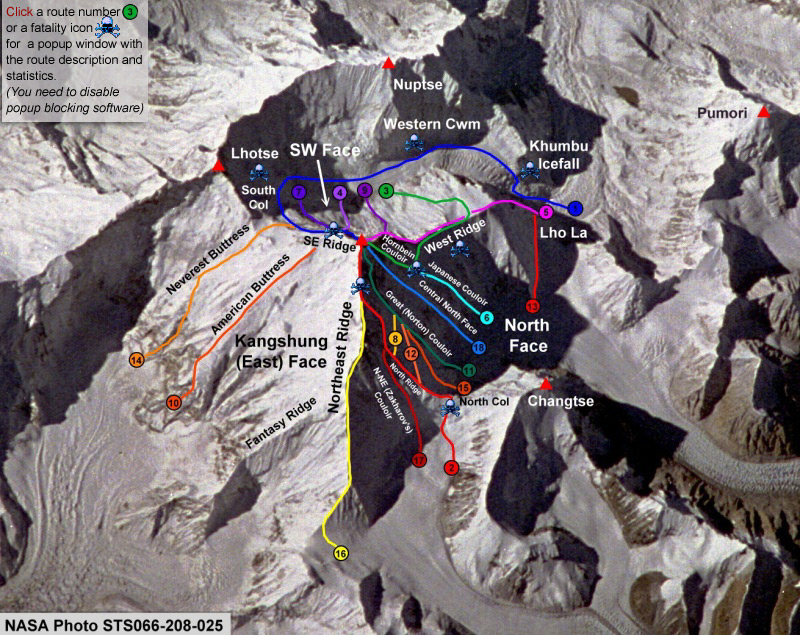
It is challenging to analyze the routes because they are often named after their geological features, the national team, or even the person who first climbed them. However, about 20 climbing routes have been identified on Mt. Everest. Everest has three faces: the Southwest Face from Nepal, the East Face, aka Kangshung Face, from Tibet, and the North Face, also from Tibet. The Kangshung Face has seen the fewest attempts and even fewer summits.
Non-Standard routes
The non-standard routes have many variations. For example, you can climb the standard Northeast Ridge to the summit and return via the Great Couloir or the North Face. The Southwest Face is also popular; this variation includes the Bonington Route and climbing via the Rib. While most climbers on the north side take the Northeast Ridge route, they join the ridge in the middle. A Japanese team made the first ascent of the true Northeast Ridge in 1995. The route starts at roads and ends at 5,150 meters. One section of that route is called the Pinnacles and is highly technical and challenging. Navigating this section took them three days and 1,250 meters of rope. An interesting bit of trivia is that through December 2024, of the 12,884 summits, only 187 (141 members and 46 hired) took a “non-standard” route, not the Southeast or Northeast Ridge, to the summit. There were 70 (44 members and 26 hired) deaths on these climbs–21% of the total deaths, which partly explains why the standard routes are most popular with commercial operators–lower risks. The countries with the most summits on the non-standard routes are Nepal (67), Japan (26), the USA (27), S. Korea (23), the USSR (23), and Russia (16.) Using the Himalayan database, I researched the non-standard routes to get an idea of the volume on these routes. This is not an all-inclusive list.
ROUTE
SUMMITS
DEATHS
LAST ATTEMPT
Khumbutse-W Ridge-N Face (Hornbein Couloir)
2
1
1989
Lho La-W Ridge
19
2
1989
N Face
24
0
2004
S Pillar
45
1
2000
SW Face, including the Bonington Route
48
2
2009
West Ridge- North Face- Hornbein Couloir
8
0
1986
E Face
12
0
1999
The Deadly Route?
As this chart shows, climbing the standard routes accounts for 79% of the deaths, with the Southeast Ridge dominating all deaths at 175 or 52%. This number is heavily driven by the 2023 record of eighteen deaths and the 2014 ice serac release off the West Shoulder of Everest onto the Khumbu Icefall, taking 17 lives. Also, 14 people died at Basecamp in 2015 after a 7.8 magnitude earthquake caused an avalanche off the Pumori-Lintgren ridgeline. Whether these were one-time events or ongoing concerns has yet to be determined, but in any case, climbers must carefully evaluate the risk of any route.Analyzing these death statistics more closely shows that on both sides, descending from the summit is significantly more deadly for members, with 46 deaths compared to 12 ascending on the Nepal side. From Tibet, 43 climbers died while descending and 6 ascending. Here is the death summary by routes through 2024:
Reason
Northeast Ridge (Tibet)
Southeast Ridge (Nepal)
Other Routes South
Other Routes North
total
Avalanche
9
41
13
14
77
Fall
18
34
18
8
78
AMS
12
31
0
5
48
Exposure/Frostbite
11
10
2
3
26
Illness (non-AMS)
5
18
1
1
26
Exhaustion
12
17
0
1
30
Icefall Collapse
0
17
2
0
19
Crevasse
0
10
0
0
10
Disappearance
4
6
0
3
13
other/unknown
3
2
1
1
7
Falling Rock/Ice
0
5
0
0
5
Total
74
191
34
36
335
Death Rate for those above BC
0.89
1.02
2.28
1.83
% of Total
21%
52%
13%
12%
“Unclimbed” Routes
Many sections of Everest have not been climbed, and some Faces have not been climbed in a direct line, aka direttissima. A case can be made that the complete route has not been climbed when combining different routes. This example applies all over Everest. However, there are some clear (I think) examples like the Southwest Face Direct, North Face Direct, and East Face (Kangshung) Direct. There is one route that clearly remains unclimbed, the East Ridge, also known as Fantasy Ridge. This extremely dangerous and avalanche-prone area has been deemed unclimbable in years with little snow, as Dave Watson and the team on the Fantasy Ridge showed in 2006.
Hello from Alan Arnette
Summit Coach is a consulting service that aids climbers worldwide in achieving their goals through personalized consulting services rooted in Alan Arnette’s 30 years of high-altitude mountaineering experience and 30 years as a business executive. At 58, he currently holds the American age record for summiting K2. We have supported many climbers in reaching their goals, from a Colorado 14er to Aconcagua, Denali, Cotopaxi, Everest, and even K2. We invite you to explore the Summit Coach website for consultation services and pricing details.
New Routes
The last team to complete a new route was a Korean team on the Southwest Face in 2009. In 2019, Cory Richards and Esteban “Topo” Mena made a valiant attempt to send a 6,551-foot direct line in a couloir, a narrow rock gully, on the Northeast face of Everest. The gully joins a high ridge, continues to a steep face, and on to the summit. The route began just above Advanced Base Camp at 21,325 feet on the Tibet side of Everest. Eventually, they turned back at around 7,600 meters due to “conditions we encountered coupled with our chosen tactics compounded by exertion.” after spending 40 hours on the wall with one open bivvy.
Everest Faces
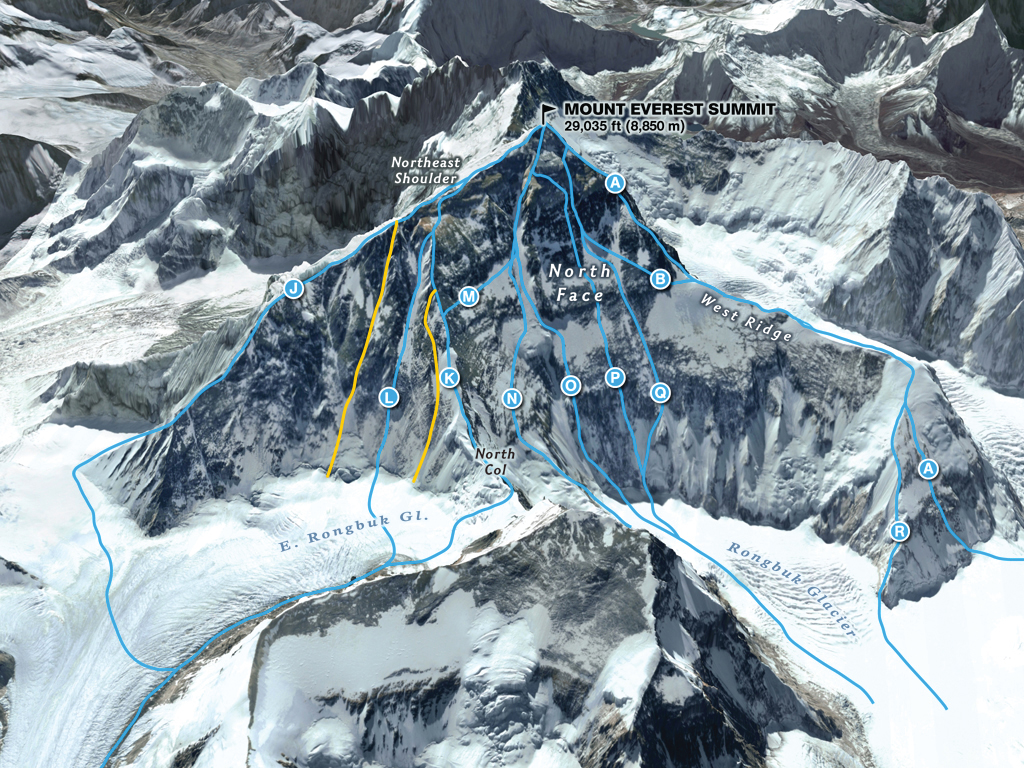
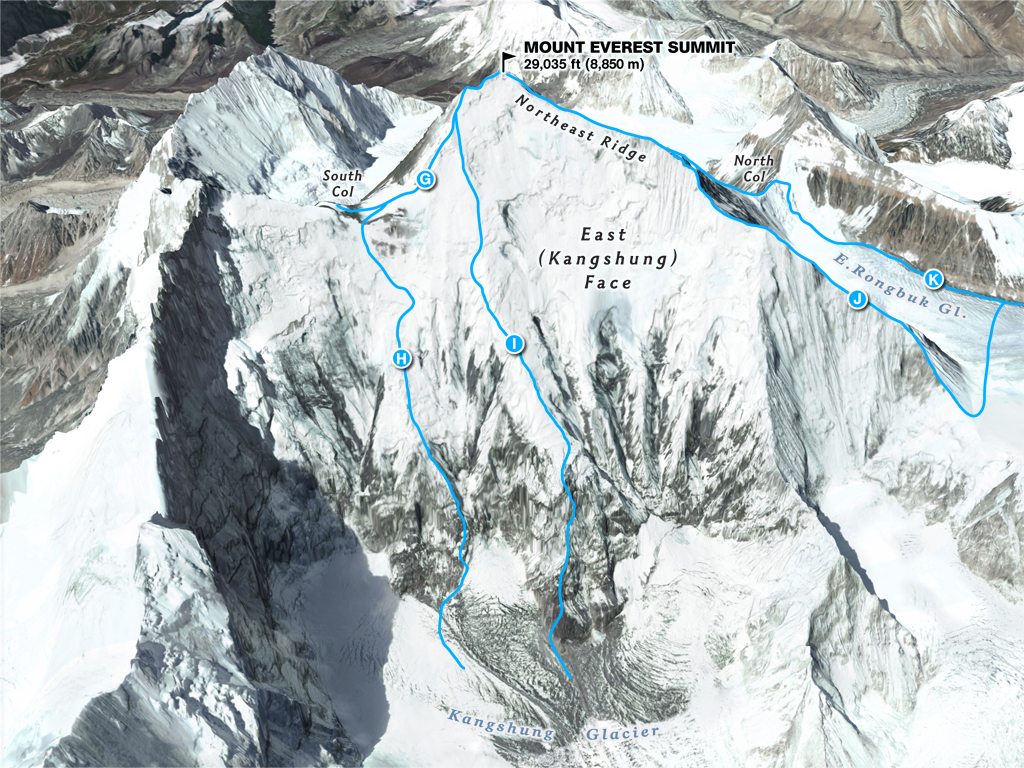
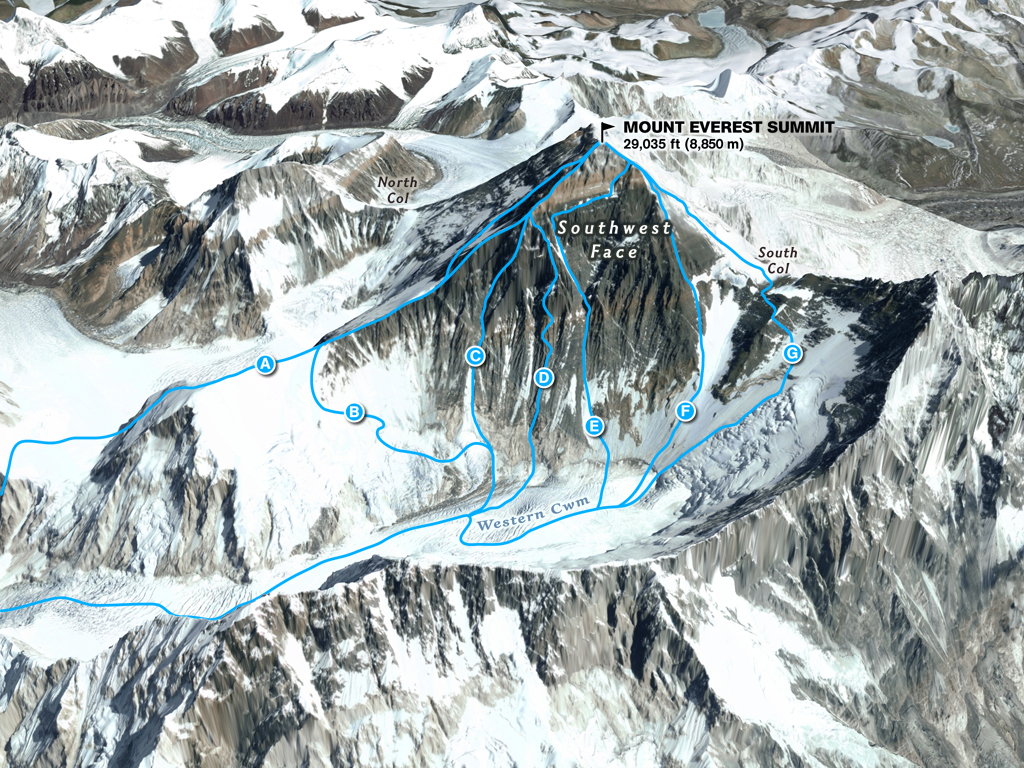
This is a list by Face with descriptions that include the common names plus some used by the Himalayan Database. The illustrations are courtesy of National Geographic (Martin Gamache, Jaime Hritsik, Chiqui Esteban, Ng Staff Sources: 3D Reality Maps; The American Alpine Journal; The Himalayan Database; Ed Webster; East Face Imagery Courtesy Of Digital Globe @ 2012; Raphael Slawinski). National Geographic had a great piece about a proposed new route in 2015, with an excellent article and animations, but it has since taken it down.
North Face
(J) Integral N.E. Ridge – 1995 Japanese team
(L) Russian Couloir – 2004 Russian
(K) The Complete NE Ridge, N-NE
(M) South Pillar, NE Ridge-N Face-Norton Couloir I – Messner Solo Route 1980 Messner Italian
(N) American Direct – 1984 American
(O) The Great Couloir aka Norton Couloir (White Limbo) – 1984 Australian
(P) Russian Direct – 2004 Russian
(Q) Japanese Supercouloir – 1980 Japanese
(A) West Ridge Direct – 1979 Yugoslavian
(R) Canadian Variation – 1986 Canadian
North Face Everest Routes
East Face
(H) East Face-S Col: Neverest Buttress – 1988 International
(I) Southwest Pillar, East Face: American Buttress – 1983 American
(J) Integral N.E. Ridge – 1995 Japanese
(K) N. Ridge/N.E. Ridge – 1960 Chinese
East Face–Everest Routes
Southwest Face
(A) American West Ridge – 1963 American
(C) Korean (Park) – 2009 South Korean Team
(D) Russian Buttress – 1982 Soviet
(E) Southwest Face – 1975 British
(F) South Pillar – 1980 Polish
G) South Col – 1953 British
Southwest Face–Everest Routes
Everest Routes by Pete Poston. Scott Parazynski, MD, took a photo during Space Shuttle mission STS-66 in November 1994.
Standard Routes
By now, you know two routes dominate Everest, with 12,697 out of the 12,884 summits following the same basic route pioneered in 1953. John Hunt’s British expedition to the summit used the Southeast Ridge-South Col, and Shi Zhang’s 1960 summit used the Northeast Ridge-North Col. Today, these routes seem to be caught up in guide politics regarding which is safer, the degree of difficulty and the opportunity for success. Either side can make an argument for climbing.
Southeast Ridge – South Col Route
Pluses
Concerns
Beautiful trek to base camp in the Khumbu
Khumbu Icefall instability
Easy access to villages for pre-summit recovery
Crowds, especially on summit night
Helicopter rescue from as high as Camp 3 at 23,500’–if necessary
Cornice Traverse exposure and Hillary Step cornice instability
Slightly warmer sometimes, with lower winds
Slightly longer summit night
Northeast Ridge – North Col Route
Pluses
Concerns
Fewer people (half of the Nepal side)
Colder temps and harsher winds
Can drive to base camp
Camps at higher elevations
Easier climbing to mid-level camps
More difficult with smooth or loose rocks
Slightly shorter summit night
Currently, there is no opportunity for helicopter rescue at any point
Now, let’s take an in-depth look at both sides.
South Col Route
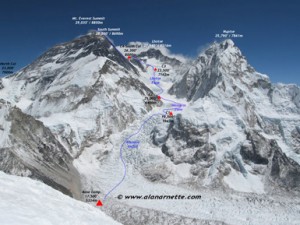
Mt. Everest was first summited by Sherpa Tenzing Norgay and New Zealander Edmund Hillary with a British expedition in 1953. They used the South Col route, which had only been attempted twice by Swiss teams in the spring and autumn of 1952. They reached 8,500 m, well above the South Col. Norgay was with the Swiss, thus gaining the experience he used on the British expedition. The Swiss returned in 1956 to make the second summit of Everest. This is a typical south-side climb schedule showing the average time and the distance from the previous camp, plus a brief description of each section. Of course, this schedule is subject to change. Some operators running “speed” climbs will skip some of these steps. More details can be found on the South Col route page.
Acclimatization at home using Hypoxic Altitude Tent
Many climbers use altitude tents to acclimatize at heights of up to 23,000 feet in their homes before arriving in BC. This reduces the expedition to a couple of weeks and eliminates most, if not all, rotations.
Trekking Peak Acclimatization: Lobuche 20,161′
Many teams now summit a trekking peak for acclimatization, thus reducing one trip through the Icefall.
Basecamp: 17,500’/5334m
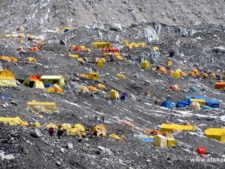
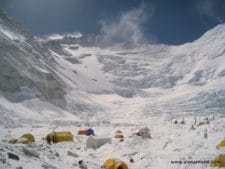
This is your home away from home. Located on a moving glacier, tents can shift, and platforms melt. The area is harsh but beautiful, surrounded by Pumori and the Khumbu Icefall with warm mornings and afternoon snow squalls. With so many expedition tents, pathways and generators, it feels like a small village.
C1: 19,500’/5943m – 4-6 hours, 1.62 miles
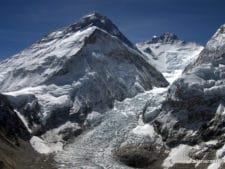
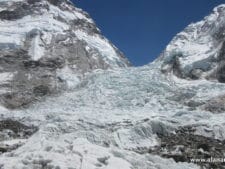
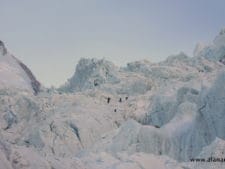
Reaching C1 can be a dangerous part of a south climb since it crosses the Khumbu Icefall. The Icefall is 2,000′ of moving ice, sometimes as much as 3 feet a day along the edges. But it is the deep crevasses, towering ice seracs and avalanches off Everest’s West shoulder that create the most danger.
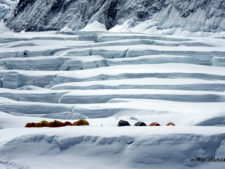
C2: 21,000’/6400m – 2-3 hours, 1.74 miles
The trek from C1 to C2 crosses the Western Cwm and can be laden with crevasse danger. But it is the extreme heat that takes a toll on climbers. Again, avalanche danger exists from Everest’s West Shoulder, which has dusted C1.
C3: 23,500’/7162m – 3-6 hours, 1.64 miles
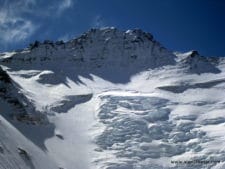
Climbing the Lhotse Face to C3 is often tricky since almost all climbers feel the effects of high altitude and are not yet using supplemental oxygen; however, today, many teams have begun using supplemental oxygen from Camp 2. The Lhotse Face is steep, and the ice is hard. The route is fixed with a rope. The angles can range from 20 to 45 to as steep as 65 degrees, slightly above the highest C3. It is a long climb to C3, and these days, few teams require it for acclimatization before a summit bid.
Yellow Band – 3 hours
The route to the South Col begins at C3 and across the Yellow Band. It starts steep but settles into a sustained grade as the altitude increases. Climbers are usually in their down suits and use supplemental oxygen for the first time. Given the altitude, the Yellow Band’s limestone rock is not complex to climb but can be challenging. Bottlenecks can occur on the Yellow Band.
Geneva Spur – 2 hours
This section can surprise some climbers. The top of the Spur leading onto the South Col has some of the steepest climbing thus far. It is easier with a good layer of snow than on loose rocks.
South Col: 26,300’/8016m – 1 hour or less
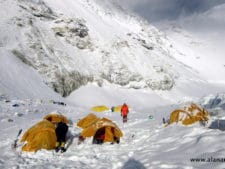
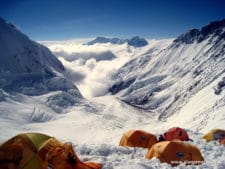
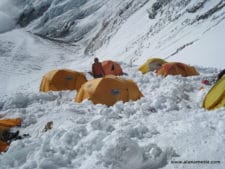
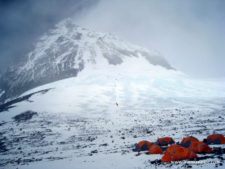
Welcome to the moon. This flat area is a saddle covered with loose rock and surrounded by Everest to the north and Lhotse to the south. Generally, teams cluster tents anchored with nets or heavy rocks against the hurricane-force winds. This is the staging area for the summit bids and the high point for Sherpas to ferry oxygen and gear for the summit bid. Today, a lot of human feces and trash need to be removed.
Balcony: 27,500’/8400m- 4 – 5 hours
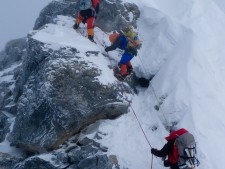
Officially now climbing Everest, climbers use supplemental oxygen to climb the steep, sustained route up the Triangular Face. The route is fixed with rope, and climbers create a long conga line of headlamps in the dark. The pace is maddeningly slow, complete with periods of full stop, as climbers above take a break to consider whether to turn back or continue to the balcony. It’s usually snow-covered, but there may be some exposed rock, depending on the year. Rockfall can be a deadly issue, and most climbers now use helmets. Sherpas will swap oxygen bottles at the Balcony while taking a short break for food and water.
South Summit: 28500’/8690m – 3 to 5 hours
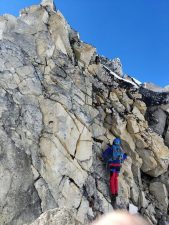
The climb from the Balcony to the South Summit is steep and continuous. Given the terrain and altitude in this section, this is the most technical and physical section. While mainly on a worn boot path in the snow, smooth rock slabs can be exposed in low-snow years. The climbing becomes more challenging as the angle dramatically steepens near the South Summit. At this point, the views of Lhotse and the sun rising to the east are indescribable.
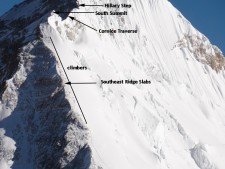
Cornice Traverse and Hillary Step – 1 hour or less
One of the most exposed sections of a south-side climb is crossing the cornice traverse between the south summit and the Hillary Step. But the route is fixed and wide enough that climbers rarely have issues. The 2015 earthquake changed the Hillary Step. Climbers now report a large snow bulb area with no rock climbing as in the past; however, in 2024, a cornice at the Step collapsed, killing two people, so speed is necessary for this area, as is avoiding overcrowding. The current ‘Hillary Slope” is still a source of bottlenecks.
Summit: 29,035’/8850m – 1 hour or less
The last section from the Hillary Step to the summit is a moderate snow slope with several small “false summits.” While tired, the climber’s adrenaline keeps them going.
Return to South Col: 4 -7 hours
Care must be taken to avoid a misplaced step down climbing the Hillary Step, the Cornice Traverse or the slabs below the south summit. Also, diligent monitoring of oxygen levels and supply is critical to ensure the oxygen lasts back to the South Col.
Return to C2: 3 hours
Usually, climbers are pretty tired but happy to return to higher natural oxygen levels, regardless of their summit performance. It can be very hot since most climbers still wear their down suits.
Return to base camp: 4 hours
The packs are heavy since everything they hauled up over the preceding month must be taken back down. It is now almost June, so the temperatures are warmer, making the snow mushy and increasing the difficulty. But each step brings them closer to base camp comforts and on to their homes and families.
This animation is based on Alan Arnette’s experience climbing Everest four times and summiting on May 21, 2011. Not all teams will use this exact schedule to summit from the Nepal side via the South Col. Some teams will only do one climb as they acclimate to other peaks or at home. Please look at the South Col route page for a more detailed description and animated route map.
Icefall Bypass?
Part of the Icefall Bypass on Nuptse. Courtesy of Marc Batard
70-year-old French alpinist Marc Batard twice, in 2021 and 2022, with a team of four French climbers and two Sherpas, attempted to establish a route to bypass the Khumbu Icefall by climbing on the flanks of Nuptse. He’s currently raising money for another attempt in 2025. He hopes to finish the route through what he calls “the traverse” to the Western Cwm and Camp 1 this spring.Nuptse is the southern wall above the Icefall. The Benegas Brothers advocated for this for many years but could never make it a reality because of the objective dangers and climbing difficulty. Batard returned in 2022 to test his new route and set an age record for a no-Os summit, but he accomplished neither. I believe the hope of climbing Nuptse’s flanks to bypass the Icefall is over, as the route is too difficult to be used commercially.
What Makes Summit Coach Unique?
At Summit Coach, we emphasize the entire preparation process for your climb beyond physical training. We begin with fitness, skills, and experience, then incorporate the mental and emotional tools necessary for a successful climb. Your teammates are welcome to join you at a discount, and we encourage your family to participate in your engagement so they understand what to expect during your climb. We strive to be affordable and provide our services at fair prices. Please visit the Summit Coach websitefor prices and offerings.
Northeast Ridge Route
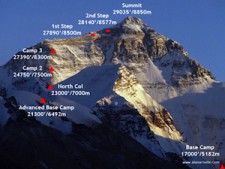
Everest’s north side is steeped in history, with multiple attempts throughout the 1920s and 1930s. The first attempt was by a British team in 1921. Brit George Mallory led a small team to be the first humans to set foot on the mountain’s flanks by climbing up to the North Col (7003m). The second expedition, in 1922, reached 27,300 feet before turning back and was the first team to use supplemental oxygen. It was also on this expedition that the first deaths were reported when an avalanche killed seven Sherpas. The 1924 British expedition with George Mallory and Andrew “Sandy” Irvine is most notable for the mystery of whether they summited or not. If they did summit, that would precede Tenzing and Hillary by 29 years. Mallory’s body was found in 1999, but there was no proof that he died going up or coming down. Irvine’s booted foot was found in 2024, but the Kodak camera, which may hold the answer to their summit, has never been found. There is speculation that the Chinese found the infamous Kodak camera and didn’t tell the world to maintain their first summit on the Tibet side. A Chinese team made the first summit from Tibet on May 25, 1960. Nawang Gombu (Tibetan) and Chinese Chu Yin-Hau and Wang Fu-zhou, who is said to have climbed the Second Step in his sock feet, claimed the honor. In 1975, on a successful summit expedition, the Chinese installed the ladder on the Second Step. Tibet was closed to foreigners from 1950 to 1980, preventing further attempts until a Japanese team summited in 1980 via the Hornbein Couloir on the North Face. The north side started to attract more climbers in the mid-1990s, but today, it sees half the traffic as the Nepal side due to China capping permits at 300 and unpredictable mountain closures. In 2008 and 2009, obtaining a permit was difficult due to the Beijing Olympics, thus preventing many expeditions from attempting any route from Tibet. And it was closed to foreigners from 2020 through 2023 because of COVID and bureaucratic delays. Now, let’s look at the typical north-side schedule, which shows the average time from the previous camp, plus a brief description of each section. Of course, this schedule is subject to change. Some operators running “speed” climbs will skip some of these steps. More details can be found on the Northeast Ridge route page.
Acclimatization at home using Hypoxic Altitude Tent
Many climbers use altitude tents to acclimatize at heights of up to 23,000 feet in their homes before arriving in BC. This reduces the expedition to a couple of weeks and eliminates most, if not all, rotations.
Basecamp: 17000′ – 5182m
It is located on a highly windy gravel area near the Rongbuk Monastery. This is the end of the road. All vehicle-assisted evacuations start here. As of 2024, there are no helicopter rescues or evacuations on the north side or for any mountain in Tibet, but this may begin in 2025 or 2026 as a tourist center has been built nearby.
Interim camp: 20300’/6187m – 5 to 6 hours (first time)
Used on the first trek to ABC during the acclimatization process, this is a spot with a few tents. Usually, this area is lightly snow-covered or just rocks.
Advanced base camp: 21300’/6492m – 6 hours (first time)
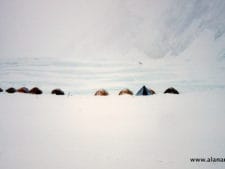
Many teams use ABC as their primary camp during acclimatization, but it is pretty high. Yaks can ferry gear from BC to ABC. This area can still be void of snow but offers a stunning view directly at the North Col. It is a harsh environment and a long walk back to the relative comfort of basecamp or Tibetan villages.
North Col or C1: 23,000’/7000m – 4 to 6 hours (first time)
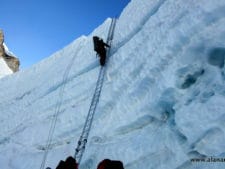
Leaving Camp 1, climbers reach the East Rongbuk Glacier and put on their crampons for the first time. After a short walk, they clip into the fixed line and perhaps cross a couple of ladders over deep glacier crevasses. The climb from ABC to the North Col steadily gains altitude with one steep section of 60 degrees that will feel vertical. Climbers may use their ascenders on the fixed rope. Rappelling or arm-wrap techniques are used to descend this steep section. Teams will spend several nights at the Col during the expedition.
Camp 2: 24,750’/7500m – 5 hours
It’s mostly a steep, snowy ridge climb that turns to rock. High winds can sometimes make the climb cold. Some teams use C2 as their highest camp for acclimatization purposes.
Camp 3: 27,390’/8300m – 4 to 6 hours
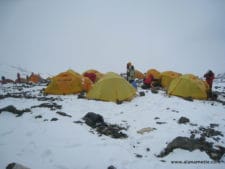
Teams place Camp 3 at several spots on the steep, rocky, exposed ridge. Now, using supplemental oxygen, tents are perched on rock ledges and are often pummeled by strong winds. This altitude and weather exposure are higher than those of the South Col. It is the launching spot for the summit bid. Today, a lot of human feces and trash need to be removed.
Yellow Band
Leaving C3, climbers follow the fixed rope through a snow-filled gully in the Yellow Band. They then take a small ramp to the northeast ridge proper.
First Step: 27890’/8500m
The first of three rock features. The route tends to cross to the right of the high point, but some climbers may rate it as steep and challenging. This one requires good footwork and steady use of the fixed rope in the final gully to the ridge.
Mushroom Rock -28047’/8549m – 2 hours from C3
A rock feature that spotters and climbers can use to measure their progress on summit night. Oxygen is swapped at this point. The route can be covered with loose rock here, adding to the difficulty with crampons. Climbers will use all their mountaineering skills.
Second Step: 28140’/8577m – 1 hour or less
This is the crux of the Chinese Ladder climb. Climbers must ascend about 10 feet of rock slab before climbing the near-vertical 30 feet ladder. This section is very exposed, with a 10,000-foot vertical drop. The descent is more challenging to navigate because you cannot see your feet on the ladder rungs while wearing an oxygen mask and goggles. This brief section is notorious for long delays, thus increasing the chance of frostbite or AMS.
Third Step: 28500’/8690m – 1 to 2 hours
It is the easiest of the three steps but requires concentration to be safe.
Summit Pyramid – 2 to 4 hours
At this point, climbers feel very exposed on a steep snow slope that is often windy and brutally cold. Towards the top of the Pyramid, climbers are extremely exposed again as they navigate a large outcropping and experience three more small rock steps on a ramp before the final ridge climb to the summit.
Summit: 29,035’/8850m – 1 hour
The final 500′ horizontal distance along the ridge to the summit is entirely exposed. Slope angles range from 30 to 60 degrees.
Return to Camp 3: – 7 -8 hours
The downclimb takes the identical route. Early summiteers may experience delays at the Second Step, with climbers going up or summiteers having downclimbing issues.
Return to ABC: 3 hours
The packs can be heavy since everything hauled up over the preceding month must be taken back down. Since it is now almost June, the temperatures are warmer, making the snow mushy and increasing the difficulty. However, each step brings them closer to base camp comforts and to their homes and families.
For a more detailed description and route pictures, please take a look at the Northeast Ridge route page.
Summary
I am often asked which side or route is safer, and my answer is to pick your poison, but the standard routes offer the safest options. The non-standard routes are the domain of elite and highly skilled alpinists, and even with their talent, the death rates soar. The south has the Khumbu Icefall on the standard routes, while the north has the Steps and Weather. However, these numbers clearly show that the South has a higher death rate. Despite the dangers of the icefall, I think most operators will say that the south side is safer and slightly more straightforward. But the real answer is no one knows what each season will bring. So train hard, gain skills on lower mountains, obtain altitude experience on another 8000m mountain before Everest, and go with a team you can count on in an emergency. Climb On! Alan Memories are Everything
The Most Common Mistakes Climbers Make
The most common mistakes climbers make include underestimating the effects of altitude on their bodies and overestimating their physical abilities. Summit Coach can help you achieve a balanced approach to preparation and clarify the confusing advice often found online. Please visit the Summit Coach websitefor prices and offerings.
Interesting article. I would prefer Mount Everest is closed until it is cleaned up and even after that it should not be treated as a carnival ride. The iconic Uluru (aka Ayers Rock) in Australia is now a sacred site and no longer open to the public to clamber over. I would like to see the same for Mount Everest
Cookie Consent
We use cookies to improve your experience on our site. By using our site, you consent to cookies.
This website uses cookies
Websites store cookies to enhance functionality and personalise your experience. You can manage your preferences, but blocking some cookies may impact site performance and services.
Essential cookies enable basic functions and are necessary for the proper function of the website.



Interesting article. I would prefer Mount Everest is closed until it is cleaned up and even after that it should not be treated as a carnival ride. The iconic Uluru (aka Ayers Rock) in Australia is now a sacred site and no longer open to the public to clamber over. I would like to see the same for Mount Everest