Aconcagua 2005 Climb
7 Summits Home | Everest | Aconcagua | Carstensz Pyramid | Denali | Elbrus | Kilimanjaro | Kosciuszko | Mont Blanc | Vinson | Compare the 7 Summits | Climb for Alzheimer’s
2011 Climb Dispatches: Vinson 2010 | Aconcagua 2011 | Everest 2011 | Denali 2011 | Elbrus 2011 | Kilimanjaro 2011 | Carstensz 2011 | Kosciuszko 2011
I climbed seven of the eight Seven Summits in 2010/11. It took 18 airlines, 58 flights, 116,112 miles flown, 120 time zones and 201 nights away from home over 322 days to raise awareness and research funds for Alzheimer’s, and to honor my mom, Ida Arnette, who was taken by this disease in 2009. Read the 7 Summits overview.
Aconcagua is a popular climb for those wanting to test themselves at high altitude. It is often a step before attempting Everest and of course one of the Seven Summits. I summited it on February 19, 2005 and again on January 8, 2008 one of my Memories are Everything®: The Road Back to Mt. Everest expeditions and again on January 29, 2011 as my 7 Summits for Alzheimer’s project.
2005 Climb


Climbing Aconcagua in Argentina has not been one of my priorities so why would I take a few weeks in the middle of winter to climb one of the 7 Summits? And why was it never on my “list”? Aconcagua is the highest mountain outside of the Himalaya range in Asia. It is famous for horrible weather and infamous for being a “slag-heap” or rock pile. After climbing it, I don’t think it gets the respect it deserves.
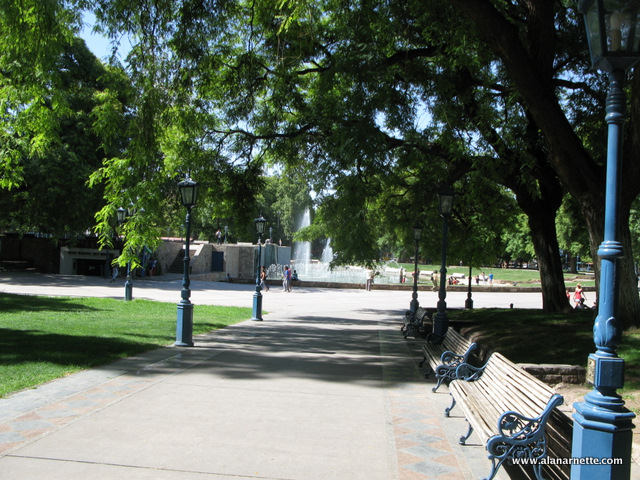
I left Colorado on February 3, 2005 for the long trip to Mendoza where I met up with our team at the Hotel Horcones. Over the next two days the others arrived and we lost one of our three guides (a “training” accident) to a severely fractured heel. Mendoza is a large city in Western Argentina serving as the primary wine making region in the country. Since it was summer in February in the Southern Hemisphere it was hot and humid. On a very late Saturday night after a great dinner and a Tango dancing show (click on the picture for the video), we saw families crowding the ice cream stores and outside restaurant tables laughing, kissing, holding hands and living the Latin affectionate life-style. It was nice to see in person. A climbing permit was required so we went to the Aconcagua Provincial Park office in Mendoza to pay our $200 fee (for this time of year). It was a simple administrative process.
The team intact, so to speak, we traveled 4 hours by minibus to Penitentes, a small ski resort at 8,500′. We stayed two nights in a dorm type environment spending our time finalizing our gear and taking an acclimatization hike to the top of the highest ski run at 10,500′. A local hound, Lorenzo, accompanied us but I don’t think he enjoyed our view of Aconcagua as much as we did. This was a critical part of our acclimatization schedule in that most climbers go as fast as they can to the base camps either up the Vacus Valley to campo Argentina on the North side or the Horcones Valley to Plaza de Mulas on the South. I believe our extra day at Penitentes enabled our success and health.
The next day we put our gear into duffle bags (44lbs maximum) to be loaded onto mules who carried a maximum of 132lbs each. We left the main paved highway and headed West up a valley following the Rio de Vacus. For the next three days we walked about 10 miles a day camping each night at an official camp site complete with Park Rangers who kept an eye out for littering. We were treated on the first night with a barbeque by our Muleteers. We legally collected scrub wood that was quickly burned into bright, glowing red embers. The meat was layed out in large slabs and slow cooked over the heat. Served on a piece of white bread, it tasted fantastic!
Day three brought our first clear view of Aconcagua. Turing South, we left the Vacus valley and gradually gained altitude as we headed towards Plaza Argentina or base camp at 13,800. Aconcagua looked huge! We could clearly see the Polish Glacier.
Arriving at base camp, we spent two days resting, finalizing what gear would go higher, what would stay for a return mule trip and taking more acclimatization hikes along with a carry of gear to Camp 1 at 16,075′. Campo Argentina is a busy place with a large Ranger presence along with “offices” for the major mule companies and local guides such as Lanko, Rudy Parra, Inka and others. A 24 hour Doctor is also on call. This year, she required that everyone register with her and get their blood pressure, pulse and, most importantly, a measure of the oxygen content in our blood. I liked this policy since it identifies anyone who is not acclimatizing properly or has an underlying health problem that may be amplified at higher altitude.
We moved to Camp 1 after three nights at BC. C1 is a few rock walled tent sites in a small gully just above a flowing river. The climb from BC is a good test for higher up on the mountain in that you experience a wide expanse of loose scree especially in the last several hundred feet up a 30 degree hillside. A similar challenge greeted us just above BC but became more of a gentle climb up the narrowing valley until the final stretch.
Three nights ended up on our schedule at C1. The first day we practiced snow and ice techniques on the nearby snow covered hillside. The next day involved a carry to Camp 2 at 19,500′. The last day we moved 1,500′ higher to Camp 1.5 at 17,500. All this climbing was designed to move gear higher as well as create more oxygen carrying red bloods using the well proven technique of climb high, sleep low. The climbing was easy in the sense that the rock covered trail was obvious, the angles manageable and the loads agreeable. Most of our team made the climbs in a few hours at the most.
However, the Polish Glacier (click for video) was a constant reminder of things to come. It never disappears from sight.
At Camp 2, we found little running water since most of the streams were frozen and there was no snow at all. Luckily there were some small depressions of water with a thick ice layer on top. Once we punched a hole through the ice, we were able to get water for cooking and drinking. However we still boiled and treated this water since it was still. The winds are ever present on Aconcagua. They are straight-line forces that destroy tents, move gear and knock over climbers. We were mindful to place large (basketball) size rocks around the perimeter of the rain fly otherwise the tents literally blew away or moved a few feet from the original site.
The original plan was for Stu (US), Suzy (Canada), Martin B (UK) and me (US) to climb the Polish Direct route and the rest of the team Rod (Australia), Mick (Australia), James (Ireland), Garth (US) and Martin (Argentina) to attack the False Polish also called the Polish Traverse or simply the Traverse. As is normal in the high mountains you hear conflicting information. Teams coming down the mountain claimed the glacier was in terrible shape with too much ice and the late season conditions had melted away more gentle angles creating 65 degree ice walls above the bottleneck on the Direct route. Others spoke of 100 m.p.h. winds and -65F degree still air temps creating unbearable frostbite. We decided to see for ourselves and make the decision a couple of days before our summit bid as to the appropriate route for us. This meant bringing all our technical gear to the base of the Glacier – ropes, crampons, ice axes, ice tools, ice crews, pickets, harnesses, carabineers, jumars, etc.
However when the time came to climb the Glacier it was just Stu and I since the others had made their own decisions to take the Traverse. We waited until 5:00 AM to leave our tents at Camp 2 and began the climb up the rock scree just to the right of the Glacier. With light winds and temperatures hovering around 10F degrees, the conditions were perfect. Dressed in two layers of long underwear, a couple of down/polarguard jackets for our core and a top layer of Gortex we stood 600′ above Camp 2 or about 20,100′. The sun was just starting to rise and a warm puff of wind brushed against our face.
I stood up after putting on my harness and crampons looking at Stu doing the same. Suddenly, I made a swift turn back towards the Glacier to see a car size block of ice falling down the slope. As it fell hundreds of smaller pieces hurled away from the main piece (the blue line on the picture on the right). It came to rest at the base of the Glacier. We looked at each other with total amazement and shock. Stu had been here the past three years and had never seen such movement on the Polish Glacier. I had been worried about the stability of the ice structure since it was mostly 20 to 30 degree and had many large features.
We had spent many hours discussing routes the past few days and had agreed to bisect a large bergschrund and take a very ascetic route mostly directly up the center of the Glacier (the red line on the picture on the right). We were both motivated and excited. However, this turn of events made us take pause. Was this a fluke? Perhaps it was triggered by the warming atmosphere – the sunrise and a mild warm front moving through the area. Or it was simply a glacier doing what glaciers do. We discussed our options: continue as planned, take a different route, retreat to Camp 2 or leave for the Traverse and try to join the rest of our team. We briefly discussed if we were being too conservative or spooked too easily.
We had only seen one other team on the Glacier. While we knew it had been climbed by several routes in February, it was unknown if the conditions had changed for certain. Suddenly it became clear to me – do not take a chance on this Glacier today. I had not come to Aconcagua to take significant risks. This was nice Hill but not the most important climb of my life. We simply did not know what we did not know. This is always true on high-altitude mountains and this time was no different with one exception. A block of snow and ice that would have killed us had come directly down the very route we were approaching and we would have been there in a matter of hours. And with that we took off across a high traverse to meet up with the Polish Traverse and eventually the summit.
We set a fast pace for an area near camp Colera where we cached our technical gear. Lightened by ten to fifteen pounds we made better time and soon passed camp Independence and the remnants of a very primitive hut. Climbing the hill above the hut we joined the main route to the Canaleta – the last 1000′ to the summit. This section was straightforward as the path was well worn and without snow. It was mostly a gentle angle of 5 to 15 degrees. However it was here I saw most people struggling with the altitude. Older men, younger men, women were taking a step every 30 seconds. They were breathing hard and had a empty look in their eyes. This was 21,000′ after all. My suspicion is that they had come up the Horcones Valley (the Normal approach) and had spent on a few nights acclimatizing and were now paying the price.
At the base of the Canaleta, Stu and I left our packs (anchored by large rocks) and took a water bottle and cameras for the final climb to the summit. This last section was the most difficult part of the climb. The rock was very loose and the route meandered aimlessly upwards. We could easily see the summit now by the throngs of climbers celebrating on the top! We met the rest of team descending after a successful summit. They were pooped. It took about an hour and a half but soon we were on the summit (click for video).
Incredibly, I think we could have made the climb from Penitentes to the summit and never touched snow. My mind was confused by this fact since most of my climbs have involved walking, sliding, sleeping and using snow for survival. I had to remind myself of just how high I was!
The first view is the famous cross on the summit of Aconcagua. Made up of tubes it was brightly decorated and serves as an icon for the summit. I had seen this for years in pictures and felt a wave of excitement at the first site. The summit itself was a large, flat expanse of rock about half the size of a football field. Climbers were everywhere taking pictures, laughing, hugging and crying. Summiting any major mountain is an emotional event and this was no different.
We took our own set of pictures and I made a satellite phone call to . I took some pictures and prepared to send them to for a website update as Stu called his wife – got the home answering machine! Business completed, I took a look around. There was Argentina, Chili, more mountains and the Pacific Ocean. But the most prominent feature was the deadly South Face. After an hour we left for the return trip to Camp 2.
Tracing our steps, we made it back in a few hours and fell into our tents reflecting on the 14 hour day. It ended as planned but not as planned. Neither of us felt an regrets about abandoning the Polish Glacier. We still feel it was the correct decision. We felt good to have made the Traverse in good time and style and to have seen our teammates along the way. After a night at C2, we left for Plaza de Mules and then back to Penitentes. Amazingly, we were in Mendoza 48 hours after our summit.
So why had I never considered this mountain? Well, I love mountains of all kinds but my heart is mostly in the Himalayas. I have focused so much on those large mountains that South America never came into focus. But it should have. Yes, Aconcagua is a large pile of rocks, but so are most mountains. Yes, Aconcagua is not technically difficult by the normal routes, but so are most popular mountains. Yes, Aconcagua is almost 7,000 meters and most popular mountains are not.
The Argentineans are unique. They are not Nepalese. They are not Alaskans. They are not Africans. Their Latin culture permeates the mountain. You cannot help but be swept in. There are more difficult routes than the Normal or the Traverse such as the South Face where two French climbers died while we were there. The Polish Direct is a world-class route that many plan for and few actually do once they see it.
Aconcagua may not get the respect from the climbing community. But once you go there; take a serious look for yourself; look into the eyes of your fellow climbers; see the dead bodies; smell the air at almost 7,000m; respect is the minimum she deserves.
Memories are Everything®
Alan Arnette is an Alzheimer’s advocate for individuals, their families and anyone impacted by this disease through his professional speaking, climbing and website.
His objectives for the Memories are Everything® climbs are:
- Educate the public, especially youth, on the early warning signs and how to prepare
- Increase awareness that Alzheimer’s Disease has no cure
- Raise research money for Alzheimer’s non-profits
He has completed two major projects:
- NO CURE, always fatal
- No easy, inexpensive method of early detection
- 3rd leading cause of death in the US
- New case every 68 seconds, 4 seconds worldwide
- Impacts more than 5+m in US, 25m+ worldwide
- Devastating financial burden on families
- Depression higher for caregivers
- Issues are increasing rapidly as population ages

The Alzheimer’s Immunotherapy Program of Janssen Alzheimer Immunotherapy and Pfizer Inc. funded my climbs for the 7 Summits campaign and ongoing efforts between November 2010 and November 2012. All money I raised then and now from donations goes directly to the organizations I have selected. During the campaign, content posted here was my own but subject to certain limitations in conjunction with the support of the AIP.
Preparing for a Climb is More Than Training
Summit Coach
From Your First Summit to Everest. One Coach, the Whole Way.
Planning your next big climb? Work one-on-one with Alan Arnette, Everest and K2 summiteer, for personalized training plans, independent guide-service advice, gear recommendations, and experienced support from preparation through expedition.
No commissions. No conflicts. Just advice focused on your success.
www.alanarnette.com is provided for informational purposes only and not for advice except through Summit Coach services.
Please see the complete disclaimer.