Climbing the World to End Alzheimer's
Aconcagua

Aconcagua 2008 Climb

I climbed seven of the eight Seven Summits in 2010/11. It took 18 airlines, 58 flights, 116,112 miles flown, 120 time zones and 201 nights away from home over 322 days to raise awareness and research funds for Alzheimer’s, and to honor my mom, Ida Arnette, who was taken by this disease in 2009. Read the 7 Summits overview.

Aconcagua is a popular climb for those wanting to test themselves at high altitude. It is often a step before attempting Everest and of course one of the Seven Summits. I summited it on February 19, 2005 and again on January 8, 2008 one of my Memories are Everything®: The Road Back to Mt. Everest expeditions and again on January 29, 2011 as my 7 Summits for Alzheimer’s project.

Aconcagua

I added Aconcagua as a “training” climb to my Memories are Everything®: The Road Back to Mt. Everest project. With climbs on Denali and Shishapangma (both without summits), I was feeling the need to get a success under my belt but also a climb with some altitude. Given it was late in 2007, I had few choices. So Aconcagua was it!

I joined a team led by Mountain Professionals Ryan Waters and Dave Elmore plus their local Chilean, Cristina Perito (the first South American woman to summit Everest). There were four other climbers – two from Canada, one from South Africa and one from France/US.

The climb was very similar to my summit in 2005. Only in 2008 there was much more snow.

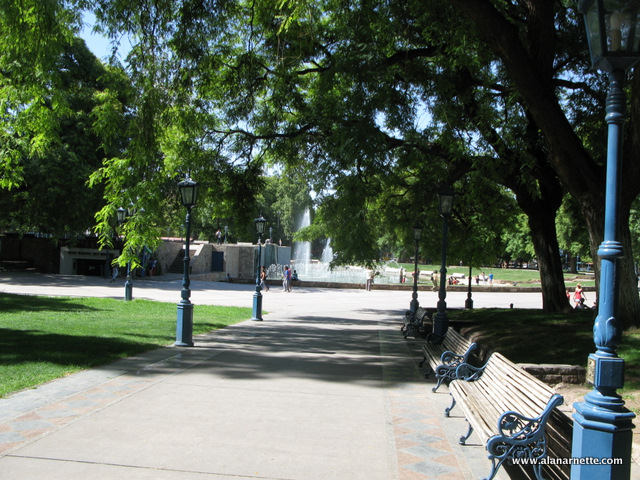
We all met in the picturesque city of Mendoza to get our climbing permits. It costs US$334 since this was the high season in the Southern Hemisphere. The permit office was quite crowded but the process was smooth and easy.

Next we traveled by minibus to Penitentes, a small ski resort at 8,500′, beside the two valleys normally used to hike to Aconcagua. We took the Vacas valley for two days before turning up the Relinchos Valley to base camp at 13,700’. The trekking was easy and enjoyable.

Relinchos Valley

Plaza Argentina is a busy place. It serves as the base camp for all expeditions and has permanent encampments fro the major mule operators such as Rudy Para, Daniel Lopez and Grajeles. They have nice domed tents which serve as dining and cooking rooms for their customers. It was nice to get out of the wind.

As I mentioned in 2005, a service provided by the Argentinean Park Rangers is to have a Doctor perform cursory check of each climber before going above BC. This involves blood pressure, pulse and oxygen saturation. I was fine at 125/70, 79 and 89 respectively. Not great at seas level but just fine at 14,000’.

The next several days saw us carry loads to camps 1 (16,000’) and Camp 2 (19,300’). The climbing is straight forward mostly on gradual to steep scree slopes. We took it easy and enjoyed the incredible views from high up. At this altitude some climbers found it difficult.

All was going according to schedule until we heard a weather forecast of 125 mph or 77 mph on the summit. This was for a few days ahead so we accelerated our schedule to get to C2 then go for the summit that same night – almost an Everest schedule. And that is what we did.

Getting up at 2:30Am on January 8th we left C2 an hour later in calm but very cold conditions. Upon reaching the normal route from the Polish Traverse, we were met with high winds. Soon we were struggling against the high winds and cold temps. But after a grueling 8 hours we were on the summit.

The next day one of our teammates revealed he had frostbite on one finger and one toe. I also felt very cold during this climb but suffered no problems. Also notable was the summit via the Polish Direct route by Dave and Rudy – well done guys!

As we were retuning down valley, the weather moved in as predicted so our timing was great. A huge lenticular cloud developed over the summit – it was amazing to watch it develop. And I was glad we were down!!


So a successful climb that pushed me hard in poor conditions – exactly what I was looking for!

2008 Live Dispatches

Memories are Everything®

Alan Arnette is an Alzheimer’s advocate for individuals, their families and anyone impacted by this disease through his professional speaking, climbing and website.

His objectives for the Memories are Everything® climbs are:

  • Educate the public, especially youth, on the early warning signs and how to prepare
  • Increase awareness that Alzheimer’s Disease has no cure
  • Raise research money for Alzheimer’s non-profits

He has completed two major projects:

  • NO CURE, always fatal
  • No easy, inexpensive method of early detection
  • 3rd leading cause of death in the US
  • New case every 68 seconds, 4 seconds worldwide
  • Impacts more than 5+m in US, 25m+ worldwide
  • Devastating financial burden on families
  • Depression higher for caregivers
  • Issues are increasing rapidly as population ages

The Alzheimer’s Immunotherapy Program of Janssen Alzheimer Immunotherapy and Pfizer Inc. funded my climbs for the 7 Summits campaign and ongoing efforts between November 2010 and November 2012. All money I raised then and now from donations goes directly to the organizations I have selected. During the campaign, content posted here was my own but subject to certain limitations in conjunction with the support of the AIP.

Preparing for a Climb is More Than Training

Summit Coach

From Your First Summit to Everest. One Coach, the Whole Way.


Planning your next big climb? Work one-on-one with Alan Arnette, Everest and K2 summiteer, for personalized training plans, independent guide-service advice, gear recommendations, and experienced support from preparation through expedition.

No commissions. No conflicts. Just advice focused on your success.

Explore Summit Coach & Book a Free 30-Minute Call

www.alanarnette.com is provided for informational purposes only and not for advice except through Summit Coach services.
Please see the complete disclaimer.